Saturday, September 28, 2024

From True Devotion To the Blessed Virgin Mary, Nos. 213-225


Wonderful Effects of this Devotion

My dear brother, be sure that if you are faithful to the interior and exterior practices of this devotion which I will point out – the following effects will take place in your soul.


First Effect: By the light which the Holy Ghost will give you through His dear Spouse, Mary, you will understand your own evil, your corruption and your incapacity for anything good. In other words, the humble Mary will communicate to you a portion of her profound humility, which will make you despise yourself, despise nobody else, but love to be despised yourself.


Second Effect: Our Blessed Lady also will give you a portion of her faith, which was the greatest of all faiths, that were ever on this earth, greater than all the faiths of all the patriarchs prophets, apostles and saints put together.


Third Effect: This Mother of fair love, will take away from your heart, all scruple and all disorder of servile fear.


Fourth Effect: Our Blessed Lady will fill you with great confidence in God and in herself because you will not be approaching Jesus by yourself, but always by that good Mother.


Fifth Effect: The soul of our Blessed Lady will communicate itself to you, to glorify the Lord. Her spirit will enter into the place of yours, to rejoice in God, her salvation, provided only that you are faithful to the practices of this devotion.


Sixth Effect: If Mary, who is the tree of life, is well cultivated in our soul by fidelity to the practices of this devotion, she will bear fruit in her own time, and her fruit is none other than Jesus Christ.


Seventh Effect: By this practice, faithfully observed, you will give Jesus more glory in a month, than by any other practice, however difficult, in many years.

Faith, Hope, Love

Faith 

Our moral life has its source in faith in God who reveals his love to us. 

Obedience of faith is our first obligation. 

Ignorance of God is the principle and explanation of all moral deviations.

Our duty toward God is to believe in him and to bear witness to him.


The first commandment requires us to nourish and protect our faith with prudence and vigilance, and to reject everything that is opposed to it. 


There are various ways of sinning against faith: 

Voluntary doubt about the faith disregards or refuses to hold as true what God has revealed and the Church proposes for belief. 

Involuntary doubtrefers to hesitation in believing, difficulty in overcoming objections connected with the faith, or also anxiety aroused by its obscurity. If deliberately cultivated doubt can lead to spiritual blindness.

Incredulity is the neglect of revealed truth or the willful refusal to assent to it. 

Heresy is the obstinate post-baptismal denial of some truth which must be believed with divine and catholic faith, or it is likewise an obstinate doubt concerning the same; 

apostasy is the total repudiation of the Christian faith; 

schism is the refusal of submission to the Roman Pontiff or of communion with the members of the Church subject to him


Hope 

When God reveals Himself and calls him, man cannot fully respond to the divine love by his own powers. 

He must hope that God will give him the capacity to love Him in return and to act in conformity with the commandments of charity. 

Hope is the confident expectation of divine blessing and the beatific vision of God; it is also the fear of offending God's love and of incurring punishment.


The first commandment is also concerned with sins against hope, namely, despair and presumption: 

By despair, man ceases to hope for his personal salvation from God, for help in attaining it or for the forgiveness of his sins. Despair is contrary to God's goodness, to his justice — for the Lord is faithful to his promises — and to his mercy.

There are two kinds of presumption. Either man presumes upon his own capacities, (hoping to be able to save himself without help from on high), or he presumes upon God's almighty power or his mercy (hoping to obtain his forgiveness without conversion and glory without merit).


Charity 

Faith in God's love encompasses the call and the obligation to respond with sincere love to divine charity. 

The first commandment enjoins us to love God above everything and all creatures for him and because of him. 

Tuesday, September 24, 2024

Rethink your entertainment

Dr. Mark Miravalle, in his book  **Time to Meet the Angels** , shares the insights of a mystic who relates what Jesus wants us to know about the Angels. “My children, **there is so much talk of the enemy and the enemy is so glorified in your world, that many souls forget that heaven is far and away more powerful than the pitiful band of bitter ones who serve darkness. These want only your misery.** Conversely, the unlimited number of good and holy servants, want only your joy and safety. But your prayers are necessary to mobilize all of this power. **In these times, many souls spend time with darkness through their activities and recreation. In doing so, souls are inviting the enemy’s companionship.** If souls do not invite our companionship, through prayers and requests, we do not force ourselves. So surround yourself with all that is Light and the enemy will avoid you. Ask for an honor guard of My angels and you will be enveloped in powerful beings from heaven who will insure that you complete your missions in safety. Children, you are God’s little creatures. You will not be abandoned.”

Monday, September 23, 2024

Love Truth and The Gospel

The Gospel:

Know the commands of God

Do the commands of God

He knows best how everything is to work after all He created it all. 

Realize that we are weak and helpless

Understand and admit we can’t do the commands

Ask Him to make us new creations

And continually ask Him to do for you what we cannot do on our own. 

Walking out new life in grace.

Asking for perseverance all the way home. 


Why we aren’t saved:

Don’t know the commands. (We do in our conscious-lie from the Devil)

Don’t believe we have to do commands (obey). 

Don’t believe he knows best, we think we do (we say some things are not sin and He says they are).  

Don’t believe we are helpless and can do some commands so we think we are okay. (Disobey one-disobedience to all)

Don’t believe anything is wrong with us. 


Beware what you teach others:

If you are telling people it’s okay to sin (because you don’t think it’s sin-BUT GOD SAYS IT IS), You are going to HELL-and taking those with you who you say is okay to sin.  


Only Those who are seeking to do God’s will are going to Heaven. (Letting him empower them in new life)


Matthew 13:41-43

The Son of Man will send out His angels, and they will gather out of His kingdom all things that offend [those things by which people are led into sin], and all who practice evil [leading others into sin], and will throw them into the furnace of fire; in that place there will be weeping [over sorrow and pain] and grinding of teeth [over distress and anger]. 


Then THE RIGHTEOUS [those who seek the will of God] WILL SHINE FORTH [radiating the new life] LIKE THE SUN in the kingdom of their Father. He who has ears [to hear], let him hear and heed My words.


Veritas: truth; reality


2 Thessalonians 2:10b

They did not welcome or receive the love of the truth [of the gospel] so as to be saved [they were spiritually blind, and rejected the truth that would have saved them].


Sunday, September 22, 2024

I can change - don’t let others control me

In this section of Jesus' sermon (Matthew 5:38-48), He teaches how to deal with the difficulties we encounter every day. You cannot control what people do to you. If they want to be offensive, rude, difficult to get along with, that's their choice. But you can control how you react to this behavior. 

The most powerful thing you can do is let it slide right away. Don't keep it in your mind; it's not worth your time, otherwise it will steal your joy all day. Don't think about it anymore; the more you think about it, the more you relive the bitterness and hurt. Don't even tell your friends what they said. Keep your heart pure. Save your emotional energy to live this day to the fullest, to follow your goals, to love your family, to be good to your neighbors. Don't go into the next 20 years letting the same things bother you, the same co-worker gets on your nerves, the same grumpy relative steals your joy. They may not change, but here's the key: you can. 

Sometimes, in the flesh we train ourselves to respond in a certain way. "If they say that, I'll get upset, I'll tell them this or that. If your crazy relative makes fun of me, I will say so." The problem is that you are letting them control you. If your smart retorts don't work a certain way, it will make your day worse. Begin to take control of your mind by surrendering it to the mind of Christ. Behave well anyway, bless and don't curse. 

The scripture says, when you are kind to your enemies, it is like heaping coals of fire on their heads (Romans 12:20). You would think that if we treated our enemies as they treated us, that would be a good payback. "If they talk bad about me, I'll talk bad about them. If they leave me out, I will leave them out. If she is rude to me, I can also play in that game. I will be rude to him." This feeling seems good for our flesh, we return it with the same currency. But Jesus said repay with love, not with the same coin. The real way you see favor and growth is to bless your enemies. 

When you are good to those who are not good to you, not only will you rise higher, but God will administer justice. He will deal with those who are not treating you right. He knows how to gather coals of fire, how to exert pressure, how to make them think differently about you.

We live in Him

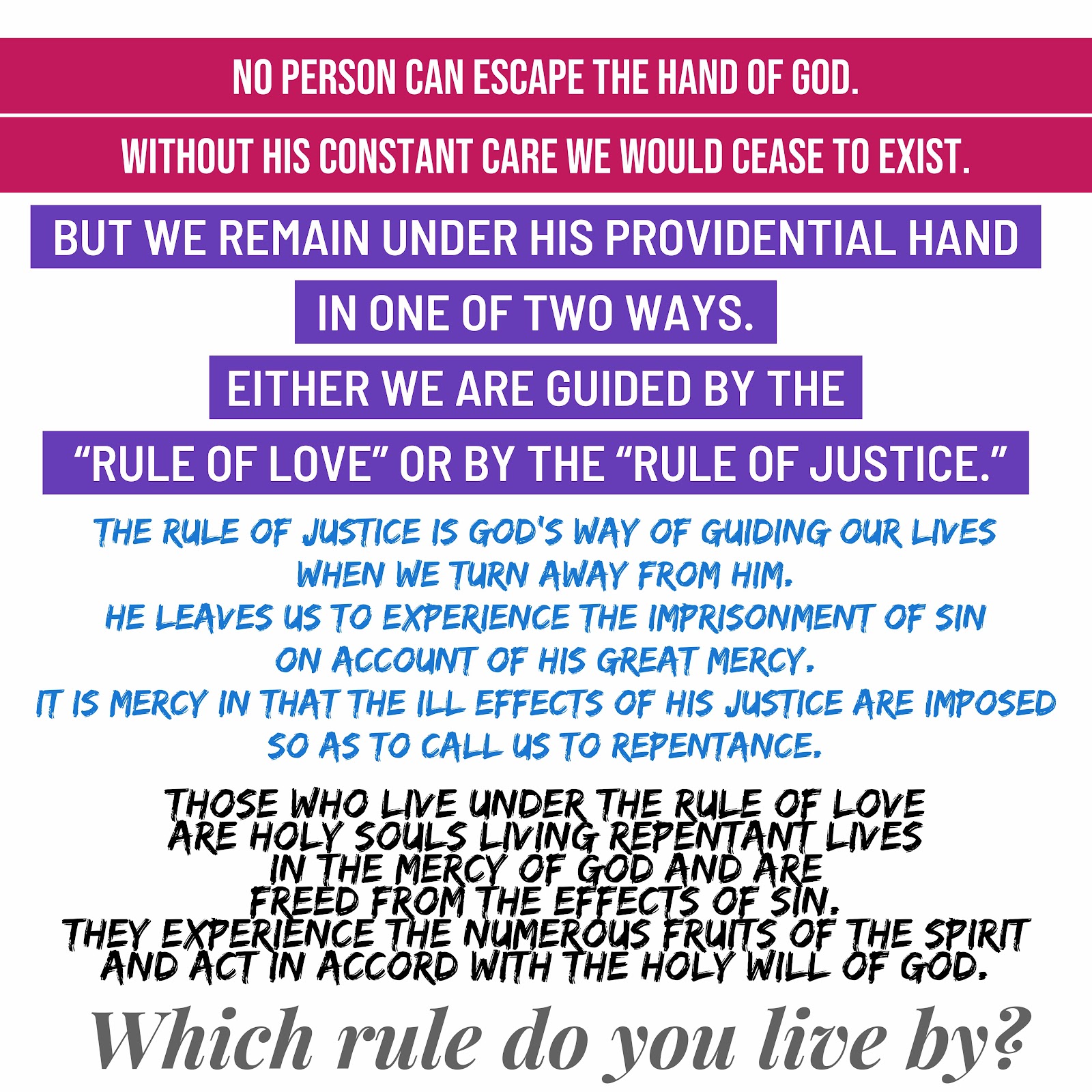
NO PERSON can escape the Hand of God. 

Without His constant care we would cease to exist. 


But we remain under His providential Hand in one of two ways. Either we are guided by the “rule of love” or by the “rule of justice.” 


The rule of justice is God’s way of guiding our lives when we turn away from Him. He leaves us to experience the imprisonment of sin on account of His great Mercy. It is Mercy in that the ill effects of His justice are imposed so as to call us to repentance. 


Those who live under the rule of love are holy souls living repentant lives in the Mercy of God and are freed from the effects of sin. They experience the numerous fruits of the Spirit and act in accord with the holy Will of God. 


Which rule do you live by? 


IN BRIEF ⇡
 
The grace of the Holy Spirit confers upon us the righteousness of God. Uniting us by faith and Baptism to the Passion and Resurrection of Christ, the Spirit makes us sharers in his life.
 
Like conversion, justification has two aspects. Moved by grace, man turns toward God and away from sin, and so accepts forgiveness and righteousness from on high.
 
Justification includes the remission of sins, sanctification, and the renewal of the inner man.
 
Justification has been merited for us by the Passion of Christ. It is granted us through Baptism. It conforms us to the righteousness of God, who justifies us. It has for its goal the glory of God and of Christ, and the gift of eternal life. It is the most excellent work of God's mercy.
 
Grace is the help God gives us to respond to our vocation of becoming his adopted sons. It introduces us into the intimacy of the Trinitarian life.
 
The divine initiative in the work of grace precedes, prepares, and elicits the free response of man. Grace responds to the deepest yearnings of human freedom, calls freedom to cooperate with it, and perfects freedom.
 
Sanctifying grace is the gratuitous gift of his life that God makes to us; it is infused by the Holy Spirit into the soul to heal it of sin and to sanctify it.
 
Sanctifying grace makes us "pleasing to God." Charisms, special graces of the Holy Spirit, are oriented to sanctifying grace and are intended for the common good of the Church. God also acts through many actual graces, to be distinguished from habitual grace which is permanent in us.
 
We can have merit in God's sight only because of God's free plan to associate man with the work of his grace. Merit is to be ascribed in the first place to the grace of God, and secondly to man's collaboration. Man's merit is due to God.
 
The grace of the Holy Spirit can confer true merit on us, by virtue of our adoptive filiation, and in accordance with God's gratuitous justice. Charity is the principal source of merit in us before God.
 
No one can merit the initial grace which is at the origin of conversion. Moved by the Holy Spirit, we can merit for ourselves and for others all the graces needed to attain eternal life, as well as necessary temporal goods.
 
"All Christians ... are called to the fullness of Christian life and to the perfection of charity" (LG 40 § 2). "Christian perfection has but one limit, that of having none" (St. Gregory of Nyssa, De vita Mos.:PG 44, 300D).
 
"If any man would come after me, let him deny himself and take up his cross and follow me" (Mt 16:24).

Saturday, September 21, 2024

Born to God

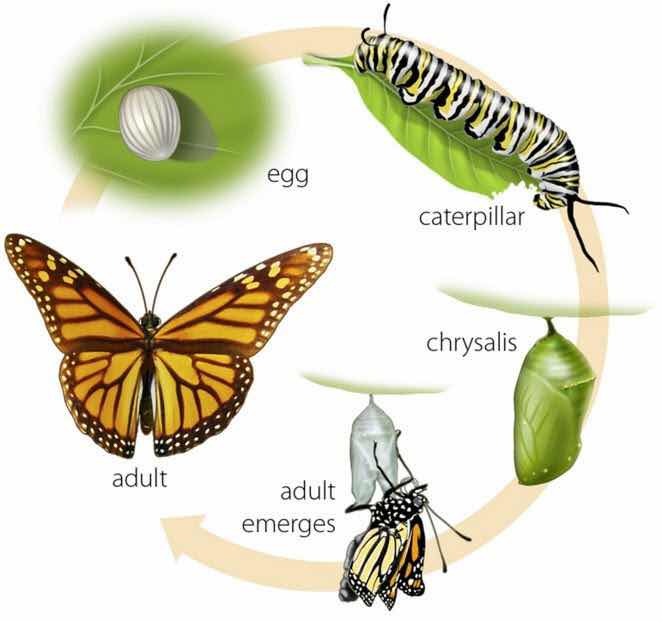
Each stage of a butterfly's life cycle looks different and serves a different purpose. The metamorphosis from caterpillar to butterfly is considered one of the most iconic transformations in nature. 


There are four stages in the metamorphosis of butterflies: 


egg: The first stage of a butterfly's life cycle. 

Born In the womb.  Being knit by God in the womb. 


larva: Also known as the caterpillar stage, this is when the butterfly eats and grows until it's too big for its skin. 

Born into the world. Live in the world doing what you think is right and learning. 


pupa: Also known as the chrysalis stage, this is when the caterpillar sheds its skin one final time and its body parts break down and reform into an adult butterfly. 

Born into Christ. Realize the world is broken and hide in Christ, learning His ways and following His directions for freedom from sin,  as the world storms around you, as you hang on to Him in the dark. 


adult: The final stage of a butterfly's life cycle, when the butterfly emerges from its chrysalis and can fly. 

Heaven. 


Thursday, September 19, 2024

Deadly Sins

DEADLY SINS

1. Murder

Murder is the intentional and premeditated act of unlawfully ending someone’s life. Murder is universally criticized since it flagrantly violates the sacredness of life. The gravity of murder is tremendous, as it encompasses the ultimate transgression of moral and ethical values, leading to irreversible repercussions. The conduct of murder is driven by a complex network of motives, which include malice, envy, vengeance, or avarice. Murder is considered a grave sin and a crime punishable by death, deserving of harsh punishment and widespread community condemnation in theological and juridical contexts.


2. Adultery

Adultery is the deliberate and mutually agreed upon involvement in sexual activities between a married person and someone who is not their legal partner. Adultery represents a significant violation of marital faithfulness and the sacredness of the marriage commitment. The action is frequently motivated by sexual wants, emotional emptiness, or the desire for forbidden pleasure, which is a major violation of moral and ethical standards. It weakens the fundamental values of trust and dedication that support the institution of marriage, causing family breakdown and public censure.


3. Theft

Theft is the illegal act of taking someone else’s property or assets without permission to deny the rightful owner of their possession permanently. Theft represents a significant breach of trust at the individual and community level, which undermines the fundamental concepts of ownership and respect for the rights of others. It is driven by avarice, despair, or malice, disturbs the balance of society, and fosters an atmosphere of apprehension and suspicion. Theft is a grave offense from a legal and moral standpoint, resulting in severe punishments and widespread condemnation.


4. Bearing False Witness

Bearing false witness means lying or giving false testimony, particularly in a legal situation. It is a profound moral and ethical infraction since it entails intentionally misleading others, which results in unfair outcomes and harm to innocent individuals. The sin is banned by the Bible’s Ninth Commandment: “Thou shalt not bear false witness against thy neighbor,” as stated in Exodus 20:16.


5. Blasphemy

Blasphemy is the act of exhibiting contempt, disrespect, or irreverence for God, sacred entities, or religious beliefs. Blasphemy, which involves speech, deeds, or expressions that insult or degrade the divine, is a severe crime of many spiritual traditions. The act is banned explicitly in the Bible, as seen by the injunction, “You shall not take the name of the Lord your God in vain,” written in Exodus 20:7, emphasizing the value of sacred honor in Christianity.


6. Apostasy

Apostasy is the formal disaffiliation, abandonment, or renunciation of one’s religious beliefs. Apostasy entails a thorough and purposeful renunciation of one’s former religious beliefs. It is one of the most severe sins, indicating an intentional departure from the faith’s doctrines, practices, and community in many spiritual traditions.


7. Despair

Despair is the complete loss or absence of hope, particularly in the context of one’s faith in God’s mercy and salvation. Despair is a grave sin in Christianity because it implies a rejection of God’s goodness, forgiveness, and the belief that He offers redemption. It contradicts the theological virtue of hope, which trusts in God’s benevolence and the promise of eternal life.

An example of despair is a person who, after committing a grave sin, believes they are beyond God’s forgiveness and stops seeking reconciliation through repentance or the sacraments. Another example is someone who faces prolonged suffering or life challenges and concludes that God has abandoned them, leading them to lose faith in God’s presence and support. Despair leads to spiritual and emotional paralysis, preventing individuals from experiencing the comfort and renewal that faith provides. It is a dangerous state because it closes the heart to God’s grace and the potential for spiritual healing and growth.


8. Gluttony

Gluttony is the excessive and wasteful intake of food, drink, or wealth objects. Gluttony is one of the seven deadly sins because it demonstrates a lack of self-control and an excessive commitment to temporal pleasures, diverting attention from spiritual things and ignoring one’s moral and spiritual responsibilities according to Christian teachings.


9. Greed/Avarice

Greed is an unquenchable desire for money, goods, or power, frequently accompanied by a refusal to share or contribute to others. Greed is a grave moral defect in many philosophical and religious traditions, including Christianity, because it indicates an excessive connection to material objects and a preference for self-interest above the well-being of others.


10. Lust

Lust is a powerful and uncontrollable drive for sexual fulfillment frequently disconnected from love, commitment, or ethical considerations. Lust is a distortion of human sexuality and a transgression of the virtue of chastity, which encourages sexual purity and respect for oneself and others. The act is a sin in many religious and moral frameworks, including Christianity, since it objectifies people, destroys relationships, and disregards the sacredness of human sexuality.


11. Sloth

Sloth, known as spiritual or moral laziness, refers to apathy, indifference, or neglect of one’s moral and spiritual responsibilities. Sloth is a lack of drive, effort, or diligence in carrying out one’s duties, whether personal, professional, or spiritual. It is considered a sin because it stifles personal growth, impedes the pursuit of virtue, and disregards the responsibilities handed to individuals by their conscience or religion in religious and philosophical settings.


12. Envy

Envy is a sense of dissatisfaction or resentment caused by another person’s assets, qualities, or accomplishments, combined with a desire to have them for oneself. Envy is regarded as a sin because it generates hostility against others and inhibits people from recognizing their gifts. It undermines the values of gratitude, contentment, and goodwill.


13. Wrath

The Latin term ire is what our acronym calls wrath. Wrath is defined as a strong feeling of hatred or resentment with a desire for vengeance. This overwhelming feeling and desire for revenge distinguishes wrath from anger that is balanced with reason, which is not a sin.


14. Pride/Vainglory

Attributing to ourselves perfections we do not really possess. Actually, possessing such a perfection but thinking we have it because we worked very hard and earned it. Possessing the perfection and knowing God gave it to us but thinking he did so because we somehow deserved it. Possessing the perfection and knowing God gave it to us undeservedly but being unwilling to share it with anyone else.

READ 3  There shall no more be anything accursed, but the throne of God and of the Lamb shall be in it, and his servants shall worship him;...