Monday, June 30, 2025

Lectio Divina: read, reflect, respond, rejoice!

My Lectio Divina: James 4:4-8

You adulterous people! Do you not know that friendship with the world is enmity with God? Therefore whoever wishes to be a friend of the world makes himself an enemy of God. Or do you suppose it is to no purpose that the Scripture says, “He yearns jealously over the spirit that he has made to dwell in us”? But he gives more grace. Therefore it says, “God opposes the proud but gives grace to the humble.” Submit yourselves therefore to God. Resist the devil, and he will flee from you. Draw near to God, and he will draw near to you. Cleanse your hands, you sinners, and purify your hearts, you double-minded.


{God loves me so much and wants to teach me the way of love. If I am looking to do the world’s ways, I  have left my love. Leaving your spouse for another lover is adultery. I do not want to be an adulterer with God. I must not look at the world or its ways. Trying to be friends with the world is putting myself at enmity with God, I am an adulteress and have made God, my only hope and love, my enemy! This will not go well. 

God, when I became his, gave me His Spirit. He years to be united in Spirit. He is jealous over the deposit he gave me. He gives grace to those who want to be His. Grace changes our hearts and minds. 

If you are looking to be friends with the world, you are prideful thinking you know better than God. He is the one who defines things-he is the creator. He says what is good and bad. For me to think I can be friends with what is an enemy of God is putting myself as opposed to Him. He opposes the proud!

If you are humble knowing you are a creature and that this world is dark and confused, call out to God for guidance. He gives grace to the humble. He wants to guide people into truth and life. But it is not like the worldly ways. 

If you admit you need God, and are willing to have humility of creature hood, he can guide you into what he made you for, union with him. Submit to God, he wants to raise you up! Draw near to him, he wants to teach you about love and truth! He will draw near to you! You have to be willing to admit your sin. You have to know you are not in charge, you don’t say what is good or not, you must ask for a new clean heart, a new purified mind in the truth. You must be willing to love God over all things in the world, including your own self. Resist the lies of the devil, he will flee. 


Thank you God Almighty for wanting to be one with me. Thank you for offering to betroth me to you. I do not want to be an adulterer. I do not want to follow or be friends with the world. I do not want to be your enemy, I want to be fully Yours! Help me. By your grace I humble myself, I admit I cannot live this life without your guidance, truth, and love. I ask for help resisting the devil and want to draw near to you. Cleanse and purify me. Help me be one in Spirit with you all the days of my life and do your will for your glory! Amen.}

Sunday, June 29, 2025

In 1 Kings 22:19-23, the Lord allowed a deceiving spirit to influence King Ahab's prophets to prophesy falsely, leading Ahab to his death


choices have consequences, and persistent rejection of God's guidance can lead to negative outcomes 4.


God's Justice

God's actions are always just, even when they are difficult to understand 1. Allowing Ahab to be deceived and meet his end in battle was a just outcome, given his persistent wickedness and rejection of God 1. As Cyprian of Carthage noted, God permits the adversary to act against us according to our sins


The incident also reflects the nature of temptation and spiritual warfare. Evil spirits seek to exploit weaknesses and lead people astray 5. In Ahab's case, his desire forValidation and his rejection of divine truth made him vulnerable to deception 5.


In summary, while it may seem that God was actively trying to destroy Ahab, the passage illustrates a complex interplay of divine sovereignty, human free will, and divine justice. God permitted the deceiving spirit to entice Ahab, but this was a consequence of Ahab's own choices and a manifestation of God's judgment on his wickedness

Salvation is not merely for those who "love God back," but rather for those who accept God's love and allow it to transform their lives. Here's a more nuanced explanation:

  1. God's Initiative of Love:

    • God's love is a free and unmerited gift, offered to all humanity 1 2 7.
    • This love is not contingent on any prior action or worthiness on the part of human beings 1 2 7.
    • God's love is most evident in that He loves humans even in their imperfection 4.
  2. Acceptance and Transformation:

    • Salvation requires a free response to God's initiative of love 5 10.
    • This response involves faith, conversion, and a turning away from sin 5 10.
    • It's not enough to simply say "I love God"; one must also allow that love to shape their actions and desires 1 36.
    • The love of God transforms individuals, enabling them to live not for themselves but for Him 3.
  3. Love in Action:

    • Love for God is demonstrated through keeping His commandments and loving one's neighbor 1 8 .
    • This is because love is not merely a feeling, but a decision to will the good of another 3 6.
    • By loving God and neighbor, individuals participate in the divine life and work towards the building of God's Kingdom.
  4. The Role of Grace:

    • Salvation is always a gift of the Holy Spirit, but it requires human cooperation 2.
    • Grace enables individuals to respond to God's love and to live according to His will 4.
    • This cooperation involves using one's intellect and will to freely seek, know, and love God.

In summary, salvation is offered to all through God's unconditional love. However, to receive salvation, one must accept God's love and allow it to transform their lives, which is expressed through faith, conversion, love of God and neighbor, and cooperation with His grace. It is not simply about "loving God back," but about allowing God's love to shape one's entire being.

[1] 1997 Joint Declaration on the Doctrine of Justification 16

[2] Redemptoris Missio 9

[3] Redemptoris Missio 10

[4] General Audience of 4 February 1998 4

[5] Evangelii Gaudium 113

[6] Placuit Deo 12

[7] Solemni Hac Liturgia (Credo of the People of God) (June 30, 1968) 23

[8] The Hope of Salvation for Infants Who Die without Being Baptised 60

[9] Placuit Deo 1

The assertion that God's love is unconditional, yet salvation requires certain conditions, raises important questions about the nature of divine love and human free will. Here's a Catholic explanation of why these concepts are not contradictory:

  1. The Nature of God's Unconditional Love:

    • God's love is freely given and unearned 4. He loves humanity because it is His nature to do so 4.
    • God's love is not based on human merit or worthiness 4.
    • The greatest proof of God's love is that He loves humans in their imperfect condition 4.
    • God's love is an offer of relationship, demonstrated through the sacrifice of Jesus Christ 1 2 7.
  2. Free Will and Acceptance of God's Love:

    • Salvation requires a free response and acceptance of God's love 11 23.
    • Faith involves a commitment of oneself to God, responding to His love with love for others and steadfast hope 11 23.
    • God created humans with intellect and will to freely seek, know, and love Him 17.
    • Humans have the freedom to either neglect or delight in God's grace 13.
    • The act of faith is a free act, and no one should be forced to embrace the faith against their will 14 15.
  3. The Necessity of Faith and Baptism:

    • Jesus Christ links faith and baptism as the way to salvation 30.
    • Baptism is the first and chief sacrament of forgiveness of sins because it unites individuals with Christ 29.
    • Faith is essential to receive the salvific gift of baptism 22 24.
    • The Church believes that no one is saved without some relation to Baptism, Eucharist, and the Church 26.
  4. Love Requires Reciprocity:

    • Love is not merely a feeling, but a decision to will the good of another 3 6.
    • Charity, or agape, is a selfless, sacrificial love that seeks the good of others 5.
    • Christ's love is a total love that claims, welcomes, embraces, and sustains individuals, transforming them to live not for themselves but for Him 3.
    • To love God means to keep His commandments and abide in His love 1.
  5. The Possibility of Rejecting God's Love:

    • Humans, seduced by the Evil One, can reject God's love 2.
    • God's grace does not constrain free will; humans may turn to God or remain in sin 19.
    • Those who do not believe will be condemned 25 30.

In summary, God's unconditional love means that He offers salvation to all. However, this offer requires a free and willing acceptance on the part of the individual. This acceptance is demonstrated through faith, conversion, baptism, and a life lived in accordance with God's love and commandments. The conditions for salvation, therefore, do not contradict the unconditional nature of God's love, but rather reflect the reality that love requires a response and that humans have the freedom to accept or reject God's offer of salvation.

[1] To the faithful gathered in the Mission Dolores Basilica of San Francisco (September 17, 1987) - Speech 

[2] General Audience of 10 March 1999 3

[3] 29 March 2007: Penitential Celebration with the Youth of the Diocese of Rome in preparation for the 22nd World Youth Day 

[4] 26 March 2006: Pastoral visit to the Roman Parish of "Dio Padre Misericordioso" 

[5] Compendium of the Social Doctrine 39

[6] Compendium of the Social Doctrine 39

[7] Doctrinal Note on some Aspects of Evangelization 4

[8] Conference 13. Third Conference of Abbot Chaeremon. On the Protection of God. Chapter 12

[9] CCC 160

[10] Dignitatis Humanae 10

[11] General Audience of 1 April 1998 1

[12] CCC 977

[13] Catechism of the Ukrainian Catholic Church: Christ – Our Pascha 416

[14] Catechism of the Council of Trent The Sacraments - Baptism

[15] The Hope of Salvation for Infants Who Die without Being Baptised 99

[16] General Audience of 26 November 2008: Saint Paul (14). The Doctrine of Justification: The Apostle's Teaching on Faith and Works 

[17] General Audience of 15 May 2024 - Cycle of Catechesis. Vices and Virtues. 19. Charity 

[18] Catechism of the Ukrainian Catholic Church: Christ – Our Pascha 848

[19] Catholic Encyclopedia Salvation

[20] CCC 183


I was so sick last night. 

Diarrhea every hour for five hours then once more after three hours. 

I overate and ate a lot of garlic. 

I had to give up salad Friday because I am overeating and making myself sick everyday-bloating and extended belly. Also the garlic makes me have blowouts every morning. Not usually at night but I guess maybe my body is tired of me making it sick. 

I actually was starting to blame you Jesus, how could you let me make myself sick and maybe have a medical event. Even though my body has been screaming at me about the salad. Everyday in pain and yet don’t stop?!?! I cut the load and then go back up. Why in the world would I blame you for my stupidity. 

And also I only have one body and one life to experience you. I only have right here and right now to know love and serve you. Why would I focus on things that are bringing me away from you and hurting my own body and mind. It was killing my soul by deafening my conscience. I was explaining away that I have given up everything why is a little lettuce and garlic so bad. Then today, I remembered….


The Israelites did complain about the lack of garlic and leeks, among other things. In Numbers 11:5, they reminisced about eating fish, cucumbers, melons, leeks, onions, and garlic in Egypt, contrasting it with the manna they were receiving in the wilderness. This complaint highlights their longing for the familiar and flavorful food of their past, even though they were now free from slavery!


Do I want what is killing me or do I want to be set free from slavery????


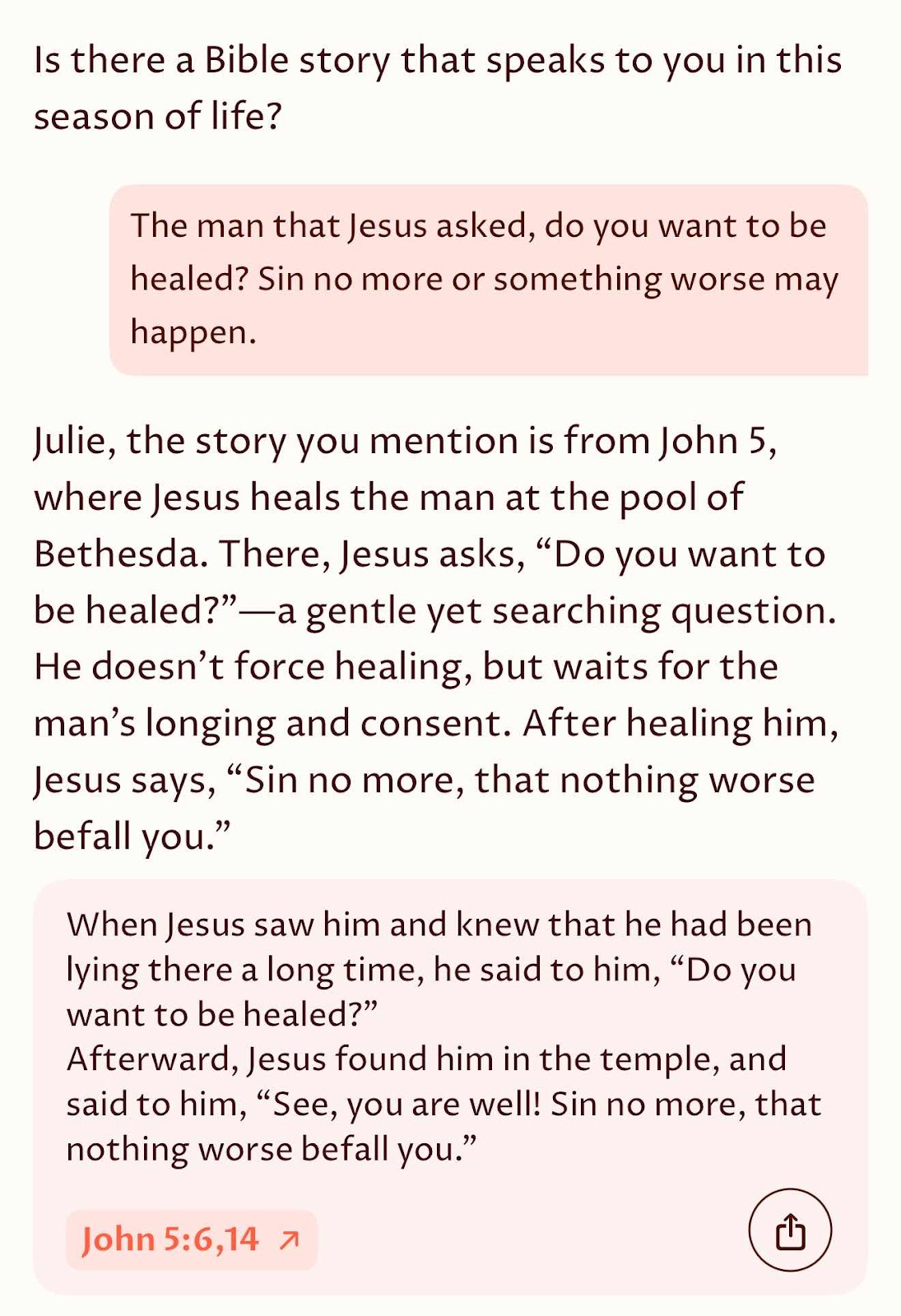
John 5:6, 14

When Jesus saw him lying there and knew that he had already been there a long time, he said to him, “Do you want to be healed?”

Afterward Jesus found him in the temple and said to him, “See, you are well! Sin no more, that nothing worse may happen to you.”


My Almighty God!!! Save Me! Give me self-control by your Holy Spirit to right my mind, heart, and body to annihilate anything that is trying to enslave me! Help me Jesus, cleanse me with your blood. Wash away my sin. Give me a new heart. Write your law on my heart mind and soul. Make me yours. Deliver me! I beg of you for mercy. Amen!


Saturday, June 28, 2025

With God ALL is Possible. God desires ALL to be saved. Faith Trusts God & Word more than thought & feelings, conviction of what is not seen (not sight). Choose Faith & Trust, only Faith pleases God. Love is greater even than Faith. 


Matthew 19:26b

With God All Things are Possible


I Timothy 2:3-4

God our Savior, desires all people to be saved and to come to the knowledge of the truth.


Faith: 

Faith trusts God’s love and promises more than shifting feelings or tangled thoughts. The Word of God does not lie. 

I must choose to trust that Jesus is present, even when my heart feels nothing. When faith is hard, you’re not failing—you are actually living the very heart of faith. 


Hebrews 11:1

Now faith is the assurance of things hoped for, the conviction of things not seen.


Hebrews 11:6

And without faith it is impossible to please him, for whoever would draw near to God must believe that he exists and that he rewards those who seek him.


I Corinthians 13:13

So now faith, hope, and love abide, these three; but the greatest of these is love.

Here are some books that can help you on your spiritual journey:

  • "The Interior Castle" by St. Teresa of Avila: A classic guide to the spiritual journey, detailing the stages of prayer and union with God 1.
  • "Dark Night of the Soul" by St. John of the Cross: This book explores the process of purification and detachment necessary for mystical union 2.
  • "Ascent of Mount Carmel" by St. John of the Cross: A guide to achieving union with God through detachment and purification 2.
  • "The Cloud of Unknowing" by an Anonymous Author: A practical guide to contemplative prayer and seeking God in simplicity 3.
  • "Spiritual Exercises" by St. Ignatius of Loyola: A manual for prayer, contemplation, and discernment to help one find God's will 4.
  • "The Practice of the Presence of God" by Brother Lawrence: This book teaches how to cultivate a constant awareness of God's presence in daily life 5.
  • "Introduction to the Devout Life" by St. Francis de Sales: Practical advice on how to grow in holiness and love of God in everyday circumstances 6.
  • "The Imitation of Christ" by Thomas à Kempis: A devotional guide that emphasizes the importance of humility, self-denial, and love of God 7.
  • "The Dialogue" by St. Catherine of Siena: A profound exploration of the spiritual life through a dialogue between St. Catherine and God 8.
  • "Way of Perfection" by St. Teresa of Avila: Practical advice and spiritual insights for those seeking a deeper relationship with God 1.

These books offer guidance, wisdom, and practical advice for those seeking to deepen their relationship with God and open themselves to the possibility of mystical union.

[1] Summa Theologiae Supplement, Q. 69, A. 3, co.

[2] Summa Theologiae III, Q. 40, A. 2

[3] Summa Theologiae III, Q. 21, A. 1, co.

[4] Summa Theologiae III, Q. 45, A. 2, co.

[5] Summa Theologiae I, Q. 12, A. 5, co.

[6] Summa Theologiae III, Q. 52, A. 8, co.

[7] Summa Theologiae Supplement, Q. 85, A. 1, co.

[8] Summa Theologiae III, Q. 11, A. 2, co.

To open yourself to the possibility of mystical union with God, consider the following points:

The Nature of Mystical Union

  • Definition: Mystical union is a profound and intimate union with Christ, participating in the mystery of Christ through the sacraments and, in Him, in the mystery of the Holy Trinity 1. It is also described as the most exalted condition attainable by the soul in this life, a "transforming union," "consummate union," or "deification" 2.
  • Goal of Perfection: According to St. John of the Cross, the one goal of perfection is to be transformed into God 3.
  • God's Initiative: The graces and signs of mystical life are gifts given to some to manifest the gratuitous gift given to all 1. God is the real protagonist in the process, and all a person can do is prepare themselves and be open to divine action 3.

Purification and Detachment

  • Inner Purification: St. John of the Cross emphasizes the need for inner purification and self-emptying to be transformed into God. This involves eliminating every disorderly dependence on things and placing God as the center and goal of life 3.
  • Purification Process: Purification begins with the life of the senses and continues with the theological virtues of faith, hope, and charity, which purify the intention, memory, and will 3.
  • Dark Night: The "dark night" describes God's intervention in purifying the soul, where the Holy Spirit consumes every impurity, subjecting the soul to trials 3.

Contemplation and Prayer

  • Acquired Contemplation: St. Alphonsus Liguori defines acquired contemplation as seeing truths at a simple glance that previously required prolonged discourse 4.
  • Mystical Union: Mystical union is also called intuitive, passive, extraordinary, or higher contemplation 4.
  • Stages of Mystical Union: St. Teresa of Avila described four stages of mystical union: incomplete mystical union or the prayer of quiet, full or semi-ecstatic union, ecstatic union or ecstasy, and transforming or deifying union or spiritual marriage of the soul with God 4.

Living the Virtues

  • Theological Virtues: Growth in faith, hope, and charity accompanies purification and union with God, leading to transformation in Him 3.
  • Love of God and Neighbor: The call to holiness involves a life of prayer, participation in the sacramental life of the Church, and an existence filled with love for God and neighbor 8.
  • Trinitarian Life: The soul is immersed in Trinitarian life, loving God with the same love with which He loves it in the Holy Spirit. There is no true union of love with God that does not culminate in Trinitarian union 3.

Experiencing God in the World

  • God in All Things: St. John of the Cross taught that the goodness in the world is present in God eminently and infinitely and that the mystic experiences the intimate connection between God and all beings 6.
  • Finding God in Creation: Experiencing awe before creation and recognizing that all things are from God 6.

Community and Shared Experiences

  • Community Life: Sharing the Word and celebrating the Eucharist together fosters fraternity and shared mystical experiences 7.

Conclusion

Opening yourself to mystical union with God involves a journey of purification, prayer, virtue, and recognizing God's presence in all things. It requires detaching from worldly attachments, embracing the theological virtues, and seeking God in both contemplation and everyday life 3 6. While mystical experiences are special graces given by God, all are called to holiness and a daily experience of love 1 8.

[1] CCC 2014

[2] Catholic Encyclopedia Mystical Marriage

[3] General Audience of 16 February 2011: Saint John of the Cross 

[4] Catholic Encyclopedia Contemplation

[5] Norms for Proceeding in the Discernment of Alleged Supernatural Phenomena 5

[6] Laudato Si 234

[7] Gaudete et exsultate 142

Yes, there is a higher love and intimacy with God that surpasses even the deepest human friendships. This is often described as mystical union or a profound, personal relationship with God achieved through prayer, the sacraments, and a life of virtue

While God loves everyone, intimacy with Him is reserved for those who seek Him with a sincere heart and strive to live according to His will 
  . This intimacy surpasses even the deepest human friendships, offering a transformative union that conforms us to Christ and enables us to share in His divine life  . By cultivating a life of prayer, participating in the sacraments, and practicing the virtues, we can all grow in this higher love and intimacy with God 

Yes, there is a higher love and intimacy with God that surpasses even the deepest human friendships. This is often described as mystical union or a profound, personal relationship with God achieved through prayer, the sacraments, and a life of virtue 1 2 3.

Intimacy with God

  • Prayer: Prayer is a primary means of developing intimacy with God 1 7. St. Teresa of Avila described prayer as "nothing but friendly intercourse, and frequent solitary converse, with him who we know loves us" 14. Through prayer, we open our hearts to God, share our joys and sorrows, and listen for His voice 1 7.
  • Sacraments: The sacraments, especially the Eucharist, are privileged encounters with Christ that deepen our union with Him 2 3. Receiving the Eucharist allows Christ to abide in us and we in Him, fostering a profound intimacy 9.
  • Theological Virtues: The theological virtues of faith, hope, and charity enable us to live in relationship with the Holy Trinity 5. Charity, in particular, is the virtue by which we love God above all things, and it is essential for growing in intimacy with Him 5.
  • Mystical Life: While extraordinary mystical experiences are rare, all the faithful are called to a daily experience of love that leads to a mystical life 2. This involves allowing ourselves to be guided by the Holy Spirit and experiencing the presence and action of the Trinity in our lives 2.

Higher than Friendship

While friendship is a valuable analogy for understanding our relationship with God, the intimacy we can experience with God transcends human friendship in several ways:

  • Unconditional Love: God's love is unconditional and unwavering 8. Human friendships, while deep, can be affected by circumstances, disagreements, or personal limitations.
  • Transformative Union: Intimacy with God transforms us from the inside out, conforming us to Christ and enabling us to share in His divine nature 4 5. Human friendships, while influential, do not have the same power to divinize us.
  • Eternal Perspective: Our relationship with God is not limited by time or space but extends into eternity 9. Human friendships, while precious, are ultimately temporary.

Examples of Intimacy with God

  • Saints: The lives of the saints provide numerous examples of profound intimacy with God 13 15. St. Clare of Assisi, St. Teresa of Avila, and St. Francis de Sales all experienced deep friendship with God that inspired their actions and shaped their lives 13 15.
  • Mary: The Virgin Mary is the ultimate example of intimacy with God 10. Her "yes" to God's will and her unwavering faith allowed her to be the Mother of God and a model for all believers 10.

Conclusion

While God loves everyone, intimacy with Him is reserved for those who seek Him with a sincere heart and strive to live according to His will 1 2 3. This intimacy surpasses even the deepest human friendships, offering a transformative union that conforms us to Christ and enables us to share in His divine life 4 5. By cultivating a life of prayer, participating in the sacraments, and practicing the virtues, we can all grow in this higher love and intimacy with God 1 2 3.

[1] Evangelica Testificatio 43

[2] Norms for Proceeding in the Discernment of Alleged Supernatural Phenomena 5

[3] CCC 2014

[4] To young people of England and Wales at Ninian Park (June 2, 1982) - Speech 3

[5] Gaudete et exsultate 149

[6] Apostolic Journey in Poland: 2 June 1997, Gorzow 3

[7] General Audience of 22 July 1998 3

[8] Lumen Gentium 42

[9] Dominum et vivificantem 59

[10] General Audience of 2 February 2011: Saint Teresa of Avila 

[11] General Audience of 15 September 2010: Saint Clare of Assisi 

[12] The Call to Communion: Anglicanorum coetibus and Ecclesial Unity God, the Source of our Communion

To do justice does not mean to do it to others because justice for all would be we should be in hell. But to do justice means to do it to ourselves to grow in holiness dependent on the Holy Spirit?


Definition of Justice: Justice is a moral virtue that entails a constant and firm commitment to giving God and neighbor what is due to them. 


Justice Towards God: This is also known as the "virtue of religion," which involves rendering to God the worship, reverence, and obedience that He is due. 


Justice Towards Others: This aspect focuses on respecting the rights of each person and fostering harmony and equity in human interactions, contributing to the common good. 


Beyond Justice: Charity goes beyond justice by prompting us to give and offer what is "mine" to the other, but it never lacks justice, which urges us to give the other what is "his," what is due to him by reason of his being or his acting. 


God's Justice and Mercy: The idea that "justice for all would be we should be in hell" touches on the relationship between God's justice and mercy. Catholic theology holds that while God's justice recognizes sin and its consequences, His mercy offers redemption and salvation through Jesus Christ. 


READ 3  There shall no more be anything accursed, but the throne of God and of the Lamb shall be in it, and his servants shall worship him;...