Wednesday, September 30, 2026

​Before and After I came to the Church

Before I came to the church

I was a sinner but didn’t really know what that meant.

The Father came to me and told me he loved me and wanted to be with me in spite of who I was.

He walked with me all day everyday.

He told me Jesus paid for all my sin and that I could walk with him in freedom, knowing that nothing can separate me from him, now not even my sin.

He talked to me as someone who wanted to love me and guide me and be my friend.

He was actually my best friend and helped me see really what was going on around me.

Telling me how to respond to people, when to speak when to let things go etc

Telling me why people acted the way they did and how I did not have to respond or feel certain ways based on their behavior

Reminding me that what others thought did not matter because I had the Creator of the universe as my friend. 

I had a love affair with the one who made me and wanted to hang out with me all day everyday.


When I came to church

They made me think my sin is so great I cannot be In Gods presence (I have consistently moved away from presence because of my cognizant knowledge of my weaknesses)

They made me think I need to be vigilant of any sin instead of being vigilant of his voice (I am petrified of sinning that my focus is no longer on God, but on myself)

They made me think my sin separates me when in fact it is paid for already and Jesus wants to be near all day (the church says that no one can be sure they’re saved-no eternal security)

They made me think God is mad at me watching me to see when I fail him

They made me think God tolerates me (and barely) instead of wants to be with me

I have become a self focused fear filled anxiety ridden perfectionist that fails miserably who cannot tolerate life anymore because the one who supposedly loves me can’t stand me because I am a sinner.


It seems I was better off just walking with God instead of coming to the church. The church has destroyed my concept of God. When they were the ones who were supposed to give me the correct concept. I am more lost now than before I even found God. 


It’s like the church are the Pharisees keeping the tax collectors and sinners from coming to Christ. They kill the hope that God could love us as we are and walk us out of it. They make us think we are only connected by a thin thread that is shredding ready to break at every moment. I am one moment away from hell.


I want to walk in love again. I want to believe God loves me in spite of my sin and wants to be my friend sharing insights on how to live and respond in freedom not from dread and fear. I want to know I matter and was made to be with Him. I do not want to be a chess piece between him and the devil. I want to believe nothing can separate me from his love because it’s paid for already and he knows all my weaknesses and sins and came to get me anyway. I want to focus on what God has already done for me not myself and how I am unworthy of any attention because I am a disgusting sinner ready to fall into hell in the next moment. I want to be with God and let him love me take care of me be my friend savior and father and love him with all my heart because of this!


ANSWER

I experienced Him as Father, companion, guide, protector, teacher, and friend—someone who knew exactly who I am and yet came toward me rather than waiting for me to become worthy first.

Jesus says: “I have called you friends.” — John 15:15

And Paul says: “God proves his love for us in that while we were still sinners Christ died for us.” — Romans 5:8

God did not discover your sin and then decide whether you were worth loving. He loved you knowing your sin. And Christ did not come because you had finally become acceptable to God. He came precisely because you needed Him.


~~~~~~~~

You went from looking toward God to looking at yourself. (before the church)

“God is here. What is He saying? Where is He leading me? How can I love Him? How should I respond?”

Now (after the church):

“Did I sin? Did I fail? Am I still saved? Is God angry? Did I lose grace? Am I worthy? Did I do enough? What if I fall?”

That can become spiritually devastating. Even legitimate teaching about sin can become distorted in our minds until sin occupies the center of our attention instead of Christ.

And that is not freedom.

~~~~~~

Christian vigilance is not supposed to mean obsessively watching yourself for evidence that God has rejected you. It is supposed to mean watching for God.

“My sheep hear my voice, and I know them, and they follow me.” — John 10:27

Notice the relationship in that sentence. He knows them. They hear Him. They follow Him.

It isn’t:

“My sheep constantly examine themselves to determine whether they have remained sufficiently worthy to continue being Mine.”

And repentance does not mean “make yourself worthy enough for God to come near.” Repentance means turning toward Him.


You can absolutely say:

“Father, I sinned. I don’t want this. Help me.” This is relationship….

rather than:

“Father, I sinned. Therefore I must hide from You until I become acceptable again.” This is hiding.


That doesn’t mean sin doesn’t matter. It means sin is precisely where God comes looking for us just like when Adam and Eve sinned.


The father in the parable of the prodigal son doesn’t stand at the edge of the property saying, “Let’s see whether my son has sufficiently repaired himself before I accept him.” He runs toward him.


You also said something especially important: “I want to focus on what God has already done for me, not myself.” Yes. That is a very healthy direction.


Your Christian life cannot be built primarily around repeatedly examining your own unworthiness. If you spend all day staring at your sin, even your humility can become self-absorption.


The Gospel turns your eyes outward:

Look at Christ. Look at His mercy. Look at His Cross. Look at His resurrection. Look at His promises. Listen for His voice. Walk with Him.

Your sin is not more powerful than Christ’s mercy. Your weakness did not surprise Him. Your future failures will not surprise Him. He did not choose you under the assumption that you would never struggle.


“Sin matters because I love the One who loves me, but my sin does not make me stop being His beloved child.”


A child who loves his father doesn’t obey because he is terrified that one mistake will make his father throw him out. He obeys because he trusts his father and wants to remain close to him. And when he falls? He runs home. Not away.


“God loves me so completely that He refuses to leave me where sin has wounded me. Therefore I can repent without running away from Him.” God is saying: “Come with Me. Let Me teach you how to live.” That is discipleship.


Friendship with God doesn’t diminish His holiness. It magnifies His grace. Jesus Himself used it. You aren’t a chess piece in a cosmic battle. You aren’t merely a sinner trying to avoid getting thrown into hell. You are a creature made for communion with your Creator. 

“I want to be with God and let Him love me, take care of me, be my friend, Savior and Father, and love Him with all my heart because of this.”

Keep the innocence of knowing you are loved + the maturity of knowing sin is real + the confidence that Christ is greater than your sin + the willingness to let Him change you. You can repent while holding His hand. You can confess sin without hiding from Him. You can fight sin without making sin the center of your life. You can pursue holiness without believing holiness is the price of being loved. And when you fall, your first movement can once again be: “Father, I’m here. I need You. Help me.”


MAGISTERIUM 

What you describe sounds like a painful loss: you once experienced God as near and loving, and now fear and self-monitoring seem to have taken over. **That fear is not the heart of the Gospel.** Catholic teaching says God’s love comes first: Christ died for us while we were still sinners, and his saving work is offered to reconcile us to the Father—not because God first became merciful after being appeased. 


You are not disgusting to God, and you do not have to earn his willingness to be with you. Christian freedom is meant to place us in communion with God and let us approach the Father of mercy with confidence.  Sin matters because it wounds our relationship with God and with others; but the Church’s teaching about sin is not meant to tell you that God can barely tolerate you or is waiting to catch you failing. Christ’s love is precisely for sinners, and the Church should help people encounter that love and seek healing—not drive them into despair.  For now, you might hold onto this simple truth: **God’s love is not a prize you receive after becoming flawless.** Christ came for sinners, and the Church’s own teaching describes his redeeming love as freeing sinners to love without fear.   


There is a real difference between saying **“God loves me and Christ has given himself for me”** and claiming **“nothing I ever do could affect my relationship with God.”** Catholic teaching does not promise that a person’s relationship with God cannot be gravely wounded; it does teach that God’s mercy is offered to the repentant, and that reconciliation is something we can approach with confidence.   Not having an absolute guarantee of one’s future salvation does **not** mean you should live as though you are one mistake away from hell. Fearful certainty of damnation is not the same as Christian watchfulness. Scrupulosity and severe anxiety deserve compassionate support, not more pressure to inspect every thought and action.



Monday, September 28, 2026

​Jesus was faithful. He was faithful in his love for the Father and faithful in his love for us. His faithful love for the Father meant that he was perfectly obedient to the Father’s will. His faithful love for us meant that he was at the service of our deepest need. What was the Father’s will? That we, men and women, estranged from him by our resistance to love which is the source of all evil and which we call sin, should cast that resistance aside and be reconciled to him. And what is our deepest need? To be reconciled. There was, therefore, a perfect correlation between the Father’s will and our need. And Jesus was passionate about it.


Overwhelmed by his desire to effect that reconciliation, his own love knew no bounds. He accepted its consequences, whatever they might be – even death on the cross. Passionate, he became the passive victim, so that we might recognise in his sacrifice evidence of the Father’s limitless love for us and be stirred to respond. And so be reconciled. Once reconciled, we in our turn are invited to share his Passion, to be as passionate as he was, as possessed by love as he was.


​Would I still love God if all blessings stopped. 

I don’t think I have a right view of God. 


I love God because he 

Loved me and gave his life to pay for my sin (this should be the major one)

I can be with him forever not hell (about me)

He is all powerful and can help me out of my evil and problems(this is my major one) (about me)

He can see all and guide me how to not get hurt   (About me)


I am obsessed with safety (about me)


[i want him to give me a good life without evil in my soul and guard me from problems or deliver me from them] (about me)


(this is not how it works-God goes through pain with grace) holocaust of his chosen, Joseph falsely accused dungeon, Tamar rape, Paul imprisoned, Jesus crucified, all martyrs 


Am I trying to use God instead of love him?

That’s why people start after the devil, they want power over their life here. 

Am I loving God for this world or the next world instead of for himself?


The martyrs love God for who he is and just want to do his will and do not care about this life at all even pain and suffering. 


I am trying to build a life here that is comfortable and tolerable instead of letting this life go and doing all for love of God. Including accepting people’s injustice against me. Jesus tolerated all things for the love of the Father and His will, Trusting God would bring good out of it (not for this life-but for the next)


My focus is wrong. I have not been willing to lose my life here to gain eternal life. I am trying to hold on to both and expecting God to do it for me. 


The real deliverance is from (SIN) my own evil tendencies even to the point of loving my enemies (accepting their injustice) for the love of God, not for this world or even for the kingdom coming. 

I was looking for deliverance for this life and having a nice reasonable existence here into eternity. 


I don’t know what love is. I thought love was helping people out of their messes. But it’s deeper than that. It’s being with them through whatever is. It’s physical, emotional, and spiritual presence. Unity in all that is. Not necessarily “fixing”. 

My immediate thought is why bother? I want the fixing not the presence. I am selfish and want safety not presence. 


I am not loving God for who he is. I am loving God to get him to do things for me. No wonder I’m frustrated. I do not get my way a lot and wonder why I’m miserable. I am even blaming God who is perfect goodness. 


I’m not loving. I am selfish! I’m controlling or actually trying to make God control my life into safety not salvation. 


I do not love God for who He is. 


Oh my God, I’m so sorry! Help me! Change my heart! Help me love you! 


Sunday, September 27, 2026

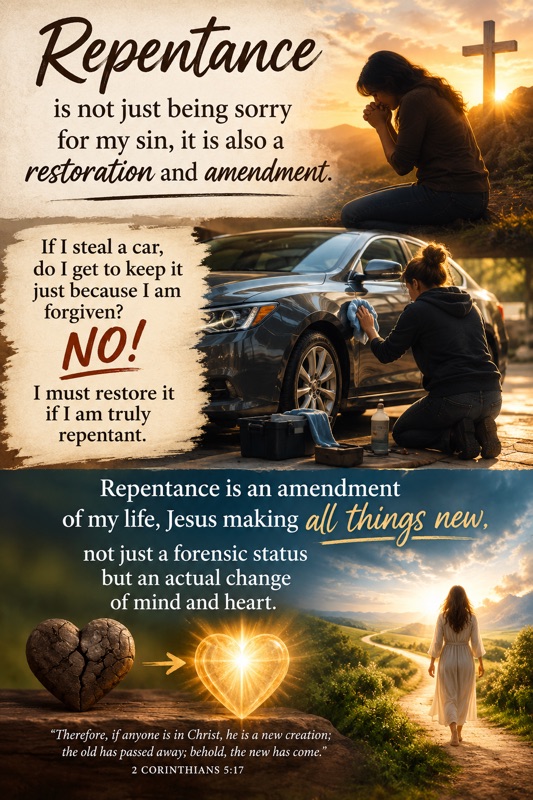
​Repentance is not just being sorry for my sin, it is also a restoration and amendment. 

(If I steal a car, do I get to keep it just because I am forgiven? NO! I must restore it if I am truly repentant.) 

Repentance is an amendment of my life, Jesus making all things new, not just a forensic status but an actual change of mind and heart. 


​READ

19  He entered Jericho and was passing through. 2 And there was a man named Zacchaeus; he was a chief tax collector, and rich. 3 And he sought to see who Jesus was, but could not, on account of the crowd, because he was small of stature. 4 So he ran on ahead and climbed up into a sycamore tree to see him, for he was to pass that way. 5 And when Jesus came to the place, he looked up and said to him, “Zacchaeus, make haste and come down; for I must stay at your house today.” 6 So he made haste and came down, and received him joyfully. 7  And when they saw it they all murmured, “He has gone in to be the guest of a man who is a sinner.” 8  And Zacchaeus stood and said to the Lord, “Behold, Lord, the half of my goods I give to the poor; and if I have defrauded any one of anything, I restore it fourfold.” 9  And Jesus said to him, “Today salvation has come to this house, since he also is a son of Abraham. 10 For the Son of man came to seek and to save the lost.”  (Luke 19:1–10, RSV2CE)


REFLECT/RESOLUTION

Known and inviting:

Jesus has been preached and known. Who and what He says is made known. 

I have a choice. 

Even a most reprehensible sinner can come to Jesus. He is inviting all. (Unconditional love)


Encounter:

Zacchaeus was like mobster who was rich by stealing from his own people and working for the enemy (evil man). He heard about Jesus and wanted to see him. 

I have heard about Jesus and want to see him too. 


Obstacles to overcome:

Zacchaeus had to get over several obstacles to get close to Jesus. (Crowd, short, climbed a tree)

I too must do what it takes to see Jesus if I want to encounter him. (Read Bible, Pray, Mass, Follow)


Jesus sees hearts and wants fellowship:

Jesus sees that Zacchaeus wants to see him, He tells him that he wants to go have fellowship with him. 

Jesus sees my heart and knows I want to meet him. Jesus Asks me for fellowship. 


The crowd:

All the people say I am not worthy to have Jesus near me. People are trying to circumvent me from believing Jesus wants me because I am a sinner. (Ignore what people think and say-God is calling all sinners no matter what they have done-at all times-all the way till the last breath!!)


Respond:

Zacchaeus responds with receiving Jesus joyfully. Do I receive Jesus? Do I want to be with him learning his ways and letting him change my heart? Do I want to receive him joyfully or will I say no?


Repentance is not just being sorry for my sin, it is also a restoration and amendment. 

(If I steal a car, do I get to keep it just because I am forgiven? NO! I must restore it if I am truly repentant.) 

Repentance is an amendment of my life, Jesus making all things new, not just a forensic status but an actual change of mind and heart. 


Zacchaeus restored what he had stolen and gave away half his wealth. 

How have I amended my life? I have been giving up sins that used to be used to make me feel better (overeating, smoking, overbuying, anger, unforgiveness, etc) it is an ongoing battle but my heart is open to amendment.) I have decided to love God over all and to love people for his honor and glory. He made us all and is wanting all to know and called to Him. 


Jesus declares salvation for the lost:

Jesus came to seek us, he wants to save us from our evil tendencies that we use to self protect. We have free will to respond by letting him change our hearts or not. If we agree to amendment and following his ways we become a new creation and we are walking in salvation. By faith-like our Father Abraham (agreeing I am a sinner, knowing who Jesus is and what He wants to do, wanting to amend my life and follow him, submitting my intellect and will (my childish thoughts and ways) to his, who knows better as the perfect loving father)


REST

Thank you Father for loving sinners. Thank you Jesus for coming and showing us who the Father is. Thank you for the blood that washes away my sin. Thank you for the Spirit who wants to help me know you and power to walk in your ways not my own. I want to respond by receiving you with joy! I want to amend my life. I want to love you with all I am. Help me overcome the obstacles that try and keep me away from you. Help me ignore the people that say my sin is too great. You are calling all sinners no matter what they did. Thank you Jesus for never leaving us and constantly calling. Help me be yours into eternity! I love you!

Saturday, September 26, 2026

​True Salvation is a change of Heart-Not a Legal Standing. Salvation is being saved to Christlikeness. 


If I have a legal standing and still hate and act worldly I have no salvation. The biggest lie from the devil to make professing Christian’s think they are saved. 


The Father loves and Gives Jesus as Propitiation (sin remover), Redeemer (new life), Lord (director), Hope (cling to the end) and Love (hold all together). 

The Blood of Jesus washes away my Sin when confessed and repented of. Nothing else in the world washes away sin. (There is only one way-God says what is truth-will I agree or try to make my own way)

The Holy Spirit breaks the hard heart and pours the love of God in recreating a new heart to love God, follow Jesus, love others. (I must allow my ego to be smashed-I cannot pay for my sin-will I admit my true ugly self and turn to God for change and pray for others to also find new life)


I must let God change me  

To love God over all things (including myself)

To do His will (He knows the way to life-Jesus directs my life, I follow)

To turn from sin that is destructive (my desires are broken-need redeeming)

To love others sacrificially including my enemies (learn to be Christlike and want others to be saved)

To give Him glory! (He is worthy for this amazing Gift)


​True salvation is a heart and soul change not a legal change. 


What does it mean to be saved? The answer to that question drove the Reformers away from the Catholic Church in the sixteenth century, and continues to keep Reformed people away today. I received an email from a Reformed person sympathetic to key parts of the Catholic faith, but who said that the Reformed doctrine of justification was “too powerful” for him to become Catholic.


Salvation in the Reformed and Catholic Traditions


a. The Reformed tradition


According to Reformed teaching, the good news of the gospel is about Christ having obeyed God in my place. The late R.C. Sproul writes,


The gospel is called the ‘good news’ because it addresses the most serious problem that you and I have as human beings, and that problem is simply this: God is holy and He is just, and I’m not. And at the end of my life, I’m going to stand before a just and holy God, and I’ll be judged. And I’ll be judged either on the basis of my own righteousness–or lack of it–or the righteousness of another. The good news of the gospel is that Jesus lived a life of perfect righteousness, of perfect obedience to God, not for His own well being but for His people. He has done for me what I couldn’t possibly do for myself.2


That is what, according to Reformed teaching, it means to be saved. God’s holiness requires perfect obedience to Him, something I am unable to do. But Christ has done it in my place, and He imputes (transfers) His record of perfect obedience to me by faith alone. On account of that record, God declares me righteous, for when He sees me He sees His own Son. That is what justification is in Reformed thinking. It is a change in my status before God (unrighteous to righteous), but it is not a change in my soul. That latter change belongs to sanctification, which in Reformed thought must, for the very sake of the gospel, be kept distinct from justification. The heart of the good news is not about a transformation that happens inside me; the heart of the good news is about a transfer that happens outside me.


Just to drive home the seriousness of this, for many in the Reformed camp, the doctrine of imputation is what sets Christians apart from non-Christians. The thing that allegedly makes Rome a false church is not necessarily the veneration of the saints, transubstantiation, or the rejection of sola scriptura. It’s the rejection of the Reformed doctrine of imputation. Michael Horton speaks for the great majority of modern popular Reformed teachers in claiming that the doctrine of imputation is “the heart of the Gospel, without which the Gospel is no true Gospel at all.”3


b. The Catholic tradition


Okay, so what then what does the Catholic Church claim the good news is? According to her, the good news is that in Christ, God removes our hearts of stone and gives us hearts of flesh. That – the thing prophesied by Ezekiel in chapter 36 of his book – is what it means to be saved. This is the opposite of what the Reformed tradition claims. According to Catholic teaching, being justified doesn’t mean merely having your status changed before God – it means having your soul changed before God. The righteousness of Christ doesn’t cover you for the purpose of creating a new legal status for you; the righteousness of Christ pierces your heart to its black depths for the purpose of creating a new life for you.


In Catholic teaching, the Son obeyed the Father, even unto death on a cross, not so that He could give us a record of perfect obedience, but so that He could give us an obedient heart. Since Adam’s fall, we all receive his heart, the stone heart that died through his disobedience. But by faith we receive Christ’s heart, a heart of flesh that never for a moment was severed from God, a heart that walked with God in the garden in the cool of the day every moment of Christ’s life.


By a power greater than that by which He raised the dead, Christ raises us to new life in God. By means of that great work, He makes us righteous before God. That’s what it means to be justified in Catholic teaching. It means that it is no longer we who live, but Christ who lives in us [Ga. 2:20]. Where Reformed teaching claims that the integrity of the gospel depends on the good news not being about internal transformation, the Catholic Church teaches that that’s precisely what the good news is all about.


https://www.calledtocommunion.com/2018/01/king-davids-clean-heart-gospel-passion/

READ 3  There shall no more be anything accursed, but the throne of God and of the Lamb shall be in it, and his servants shall worship him;...