Wednesday, February 7, 2024

The Spirit must Lead

Romans 8:13–14 
For if you live according to the flesh 
you will die, 

but if by the Spirit 
you put to death the deeds of the body, 
you will live. 

For all who are led by the Spirit of God 
are sons of God.

Tuesday, February 6, 2024

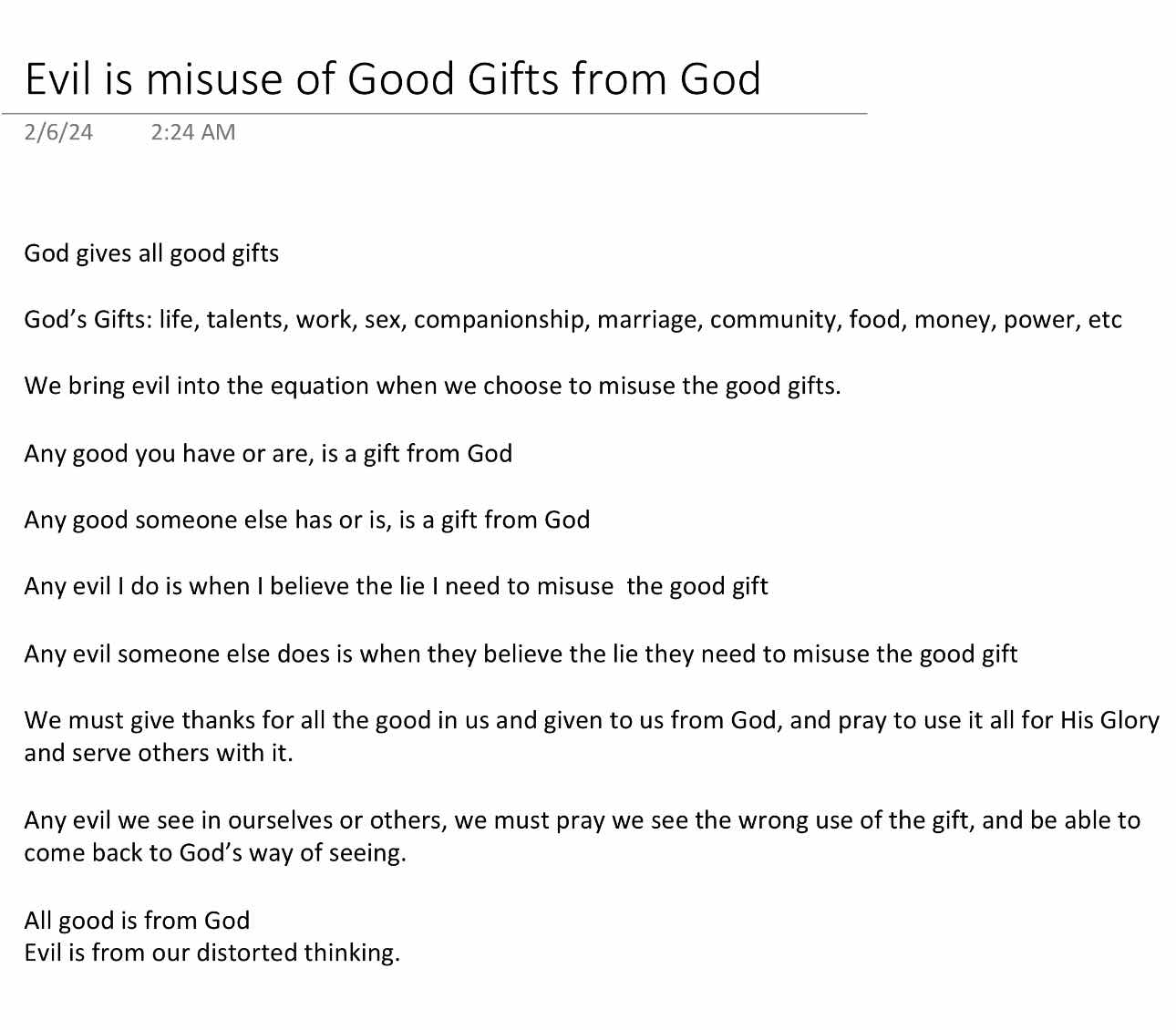
Evil is misuse of God’s Good Gifts

God gives all good gifts


God’s Gifts: life, talents, work, sex, companionship, marriage, community, food, money, power, etc


We bring evil into the equation when we choose to misuse the good gifts.


Any good you have or are, is a gift from God


Any good someone else has or is, is a gift from God


Any evil I do is when I believe the lie I need to misuse  the good gift 


Any evil someone else does is when they believe the lie they need to misuse the good gift


We must give thanks for all the good in us and given to us from God, and pray to use it all for His Glory and serve others with it. 


Any evil we see in ourselves or others, we must pray we see the wrong use of the gift, and be able to come back to God’s way of seeing. 


All good is from God

Evil is from our distorted thinking. 


Monday, February 5, 2024

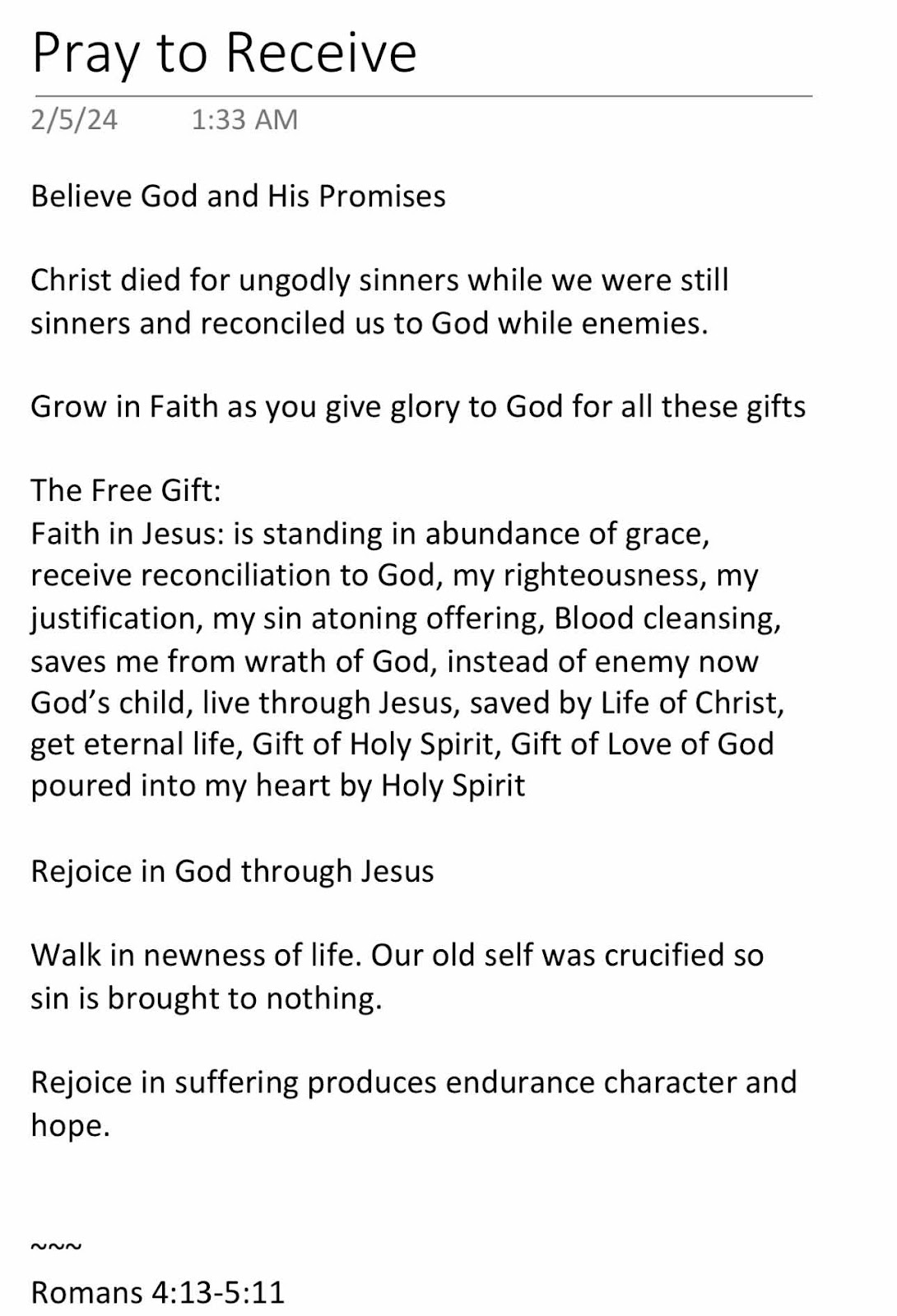
Believe God and His Promises

Believe God and His Promises

Christ died for ungodly sinners while we were still sinners and reconciled us to God while enemies. 

Grow in Faith as you give glory to God for all these gifts

The Free Gift:
Faith in Jesus: is standing in abundance of grace, receive reconciliation to God, my righteousness, my justification, my sin atoning offering, Blood cleansing, saves me from wrath of God, instead of enemy now God’s child, live through Jesus, saved by Life of Christ, get eternal life, Gift of Holy Spirit, Gift of Love of God poured into my heart by Holy Spirit

Rejoice in God through Jesus

Walk in newness of life. Our old self was crucified so sin is brought to nothing. 

Rejoice in suffering produces endurance character and hope. 

~~~
Romans 4:13-5:11


Sacramental Life

SACRAMENTAL LIFE 

Lord now that we have been set free from sin and have become slaves of God let our fruit be sanctification. (Rom 6:22) 1. In instituting the sacraments, Our Lord organized them in such a way that they accompany us in each important stage of our life. 

By baptism we are born into the life of grace; by confirmation we grow; we are nourished by the Holy Eucharist; healed by penance; by the social sacraments—holy orders and matrimony—we become supernaturally and naturally fruitful; and by the anointing of the sick we are comforted in sickness and helped on the way to eternal life. In this manner the whole of Christian life is structured and substantiated by the sacraments, which, by infusing grace, make us share in God’s life and, therefore, in his sanctity. “By God’s gifts we must hold on to and complete in our lives, the holiness which we have received” (LG 40). 

Only God is holy and only God can make holy. The initiative for man’s sanctification comes from God, and in actuality is carried out precisely through the sacraments. Spiritual life and our straining toward holiness are not simply moral obligations by which we seek to imitate the perfection of our divine model in an external way, but are based on a supernatural reality that God himself has infused into the life of a Christian, changing and transforming us from within so radically as to make us a new creation in Christ (2 Cor 5:17), “who is being renewed after the image of his Creator” (Col 3:10). God is the unique source, the primordial cause of our holiness. 

St. John says: “We love because he first loved us” (1 Jn 4:19). We may say, by way of analogy: we can become a saint because God has first of all shared his own life with us, and has called us to communion with him. 

2. Sacramental life consists of receiving, assimilating, and living the sacraments in such a way that we derive from them all the fruits of holiness and communion with God for which they are ordained. When the sacraments are conferred on persons capable of receiving them, they have of themselves unfailing effectiveness because God himself operates in them. Nevertheless, the grace and holiness that they impart do not reach their full fruitfulness unless we add our collaboration. Therefore, although God’s initiative is the first step of our sanctification, we must voluntarily collaborate with him and assimilate and live the holiness we have received from him. 

“Yield yourselves to God as men who have been brought from death to life,” says St. Paul to those who have been reborn through baptism, “and yield your members to God as instruments of righteousness” (Rom 6:13). The fact that certain sacraments, like penance and the Eucharist can be received frequently does not mean that our receiving them should become a simple habit. Habits are inert, static situations, while receiving the sacraments should always be a living act, ever more alive, so that our sacramental life is characterized by progress and development. 

This development does not necessarily consist in multiplying sacramental acts, but in intensifying and fulfilling these acts with greater perfection. This means we need to concern ourselves with approaching the sacraments with ever better dispositions, so that our own limitations may not stand in the way of the flow of grace, and that we may always participate more fully in the life of Christ in the Church. 

Our responsibility in regard to the sacraments lies in our making ourselves fit to receive them, in expanding our receptivity and making ourselves better disposed, and in being fully open to the gift that is being offered. The more we tend toward holiness and union with God, the more we ourselves must be involved in taking full advantage of the sacraments. Sacramental life is the essential and substantial reality of Christian life.

Sunday, February 4, 2024

Unconditional Love vs Approval

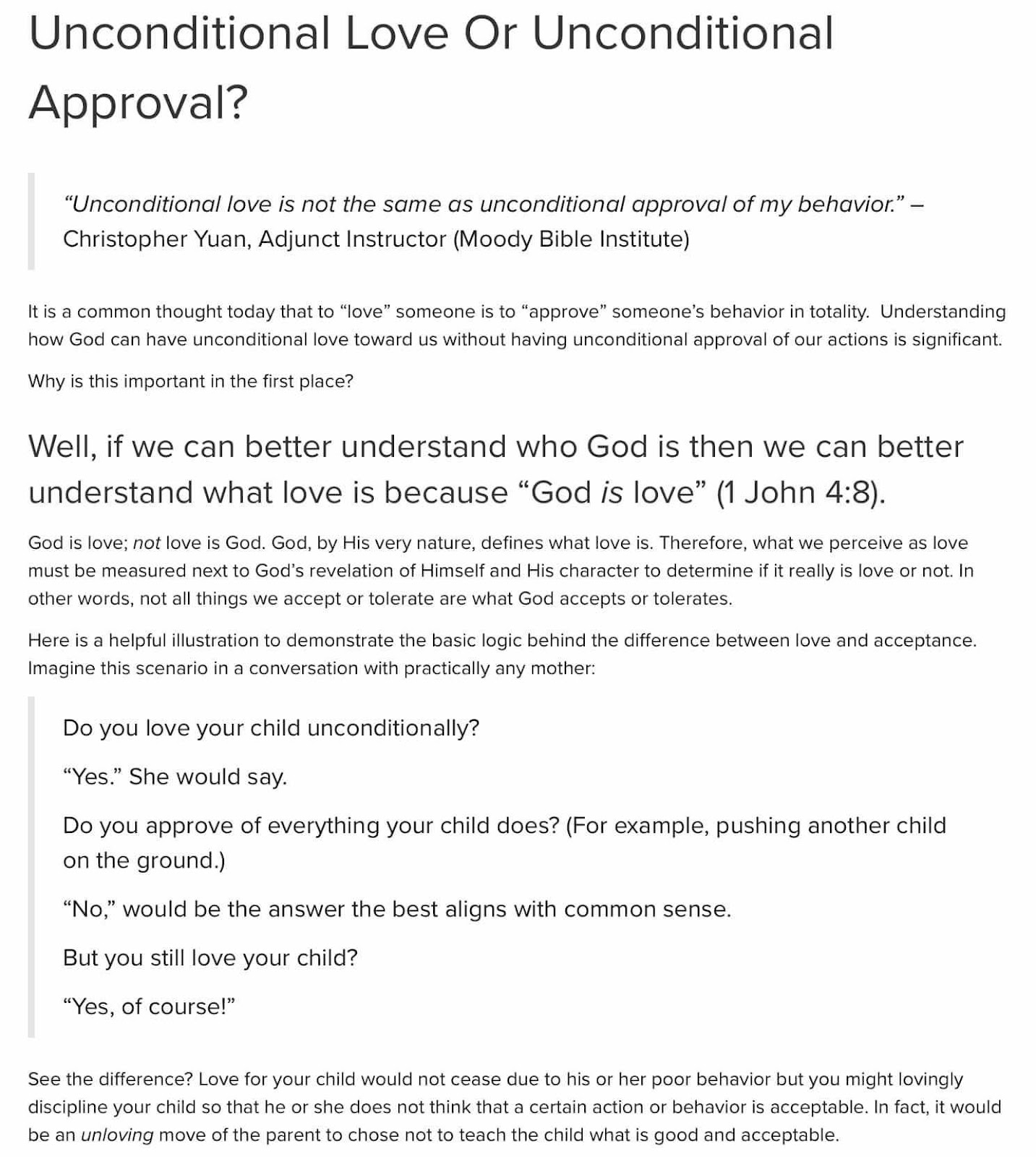
Unconditional Love Or Unconditional Approval?

“Unconditional love is not the same as unconditional approval of my behavior.” 

It is a common thought today that to “love” someone is to “approve” someone’s behavior in totality.  Understanding how God can have unconditional love toward us without having unconditional approval of our actions is significant.

Why is this important in the first place?

Well, if we can better understand who God is then we can better understand what love is because “God is love” (1 John 4:8). 
God is love; not love is God. God, by His very nature, defines what love is. Therefore, what we perceive as love must be measured next to God’s revelation of Himself and His character to determine if it really is love or not. In other words, not all things we accept or tolerate are what God accepts or tolerates.

Here is a helpful illustration to demonstrate the basic logic behind the difference between love and acceptance. Imagine this scenario in a conversation with practically any mother:

Do you love your child unconditionally?

“Yes.” She would say.

Do you approve of everything your child does? (For example, pushing another child on the ground.)

“No,” would be the answer the best aligns with common sense.

But you still love your child?

“Yes, of course!”
See the difference? Love for your child would not cease due to his or her poor behavior but you might lovingly discipline your child so that he or she does not think that a certain action or behavior is acceptable. In fact, it would be an unloving move of the parent to chose not to teach the child what is good and acceptable.

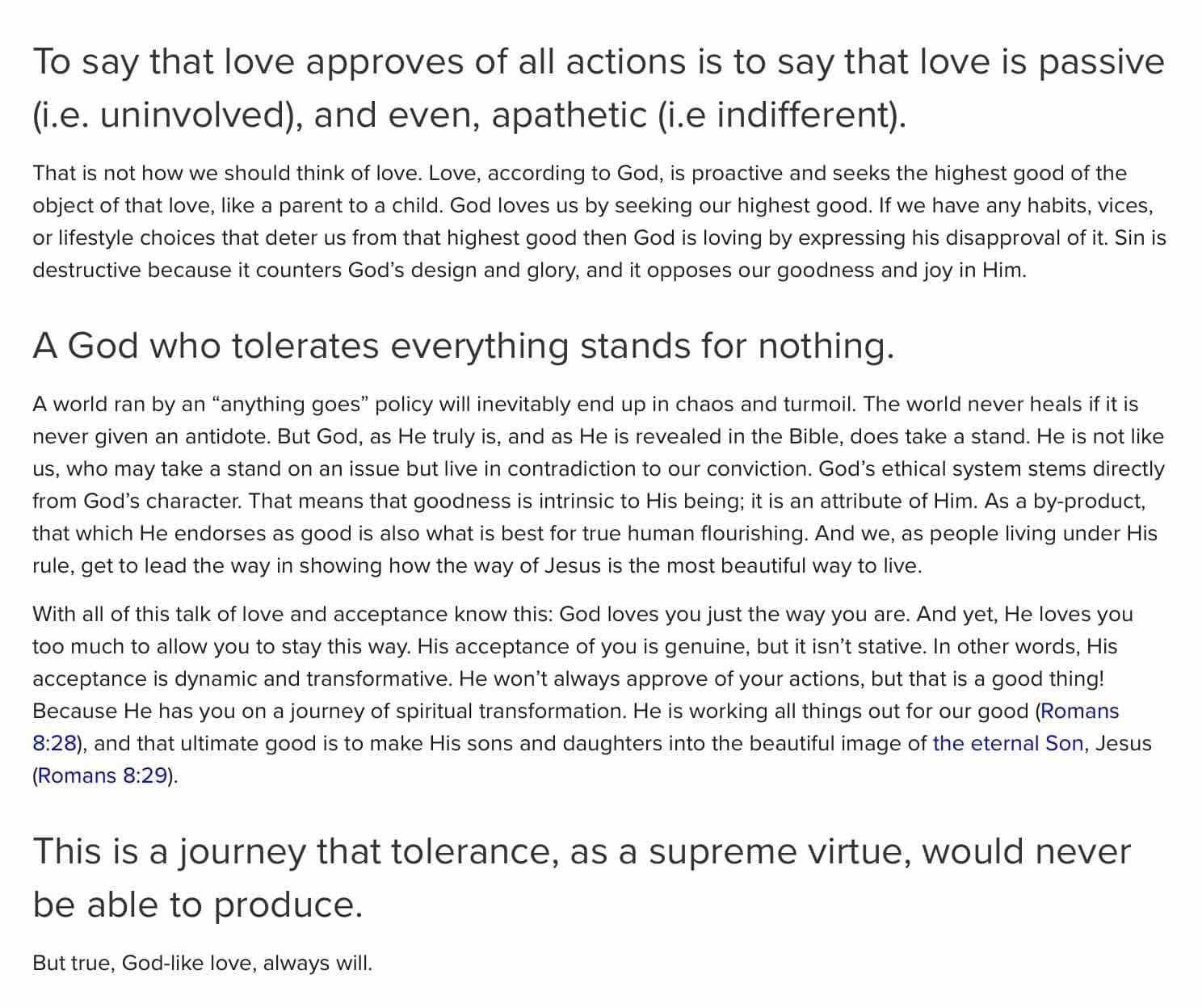
To say that love approves of all actions is to say that love is passive (i.e. uninvolved), and even, apathetic (i.e indifferent).
That is not how we should think of love. Love, according to God, is proactive and seeks the highest good of the object of that love, like a parent to a child. God loves us by seeking our highest good. If we have any habits, vices, or lifestyle choices that deter us from that highest good then God is loving by expressing his disapproval of it. Sin is destructive because it counters God’s design and glory, and it opposes our goodness and joy in Him.

A God who tolerates everything stands for nothing.
A world ran by an “anything goes” policy will inevitably end up in chaos and turmoil. The world never heals if it is never given an antidote. But God, as He truly is, and as He is revealed in the Bible, does take a stand. He is not like us, who may take a stand on an issue but live in contradiction to our conviction. God’s ethical system stems directly from God’s character. That means that goodness is intrinsic to His being; it is an attribute of Him. As a by-product, that which He endorses as good is also what is best for true human flourishing. And we, as people living under His rule, get to lead the way in showing how the way of Jesus is the most beautiful way to live. 

With all of this talk of love and acceptance know this: God loves you just the way you are. And yet, He loves you too much to allow you to stay this way. His acceptance of you is genuine, but it isn’t stative. In other words, His acceptance is dynamic and transformative. He won’t always approve of your actions, but that is a good thing! Because He has you on a journey of spiritual transformation. He is working all things out for our good (Romans 8:28), and that ultimate good is to make His sons and daughters into the beautiful image of the eternal Son, Jesus (Romans 8:29).

This is a journey that tolerance, as a supreme virtue, would never be able to produce.
But true, God-like love, always will.


True Repentance

Note:
This is true repentance. Weep bitterly over what you yourself have done to Jesus Christ. Jesus have mercy on us!

Zechariah 12:10
10 “And I will pour out on the house of David and the inhabitants of Jerusalem 

a spirit of grace and pleas for mercy, 

so that, when they look on me, on him whom they have pierced, 

they shall mourn for him, as one mourns for an only child, and weep bitterly over him, as one weeps over a firstborn. 

Only 1/3 saved

Only 1/3 saved? And only through fire and testing!

Zechariah 13:8–9 
8  In the whole land, declares the Lord, 
two thirds shall be cut off and perish, 

and one third shall be left alive. 
 9  And I will put this third into the fire, 
and refine them as one refines silver, 
and test them as gold is tested. 

They will call upon my name, 
and I will answer them. 
I will say, ‘They are my people’; 
and they will say, ‘The Lord is my God.’ ”

READ 3  There shall no more be anything accursed, but the throne of God and of the Lamb shall be in it, and his servants shall worship him;...