
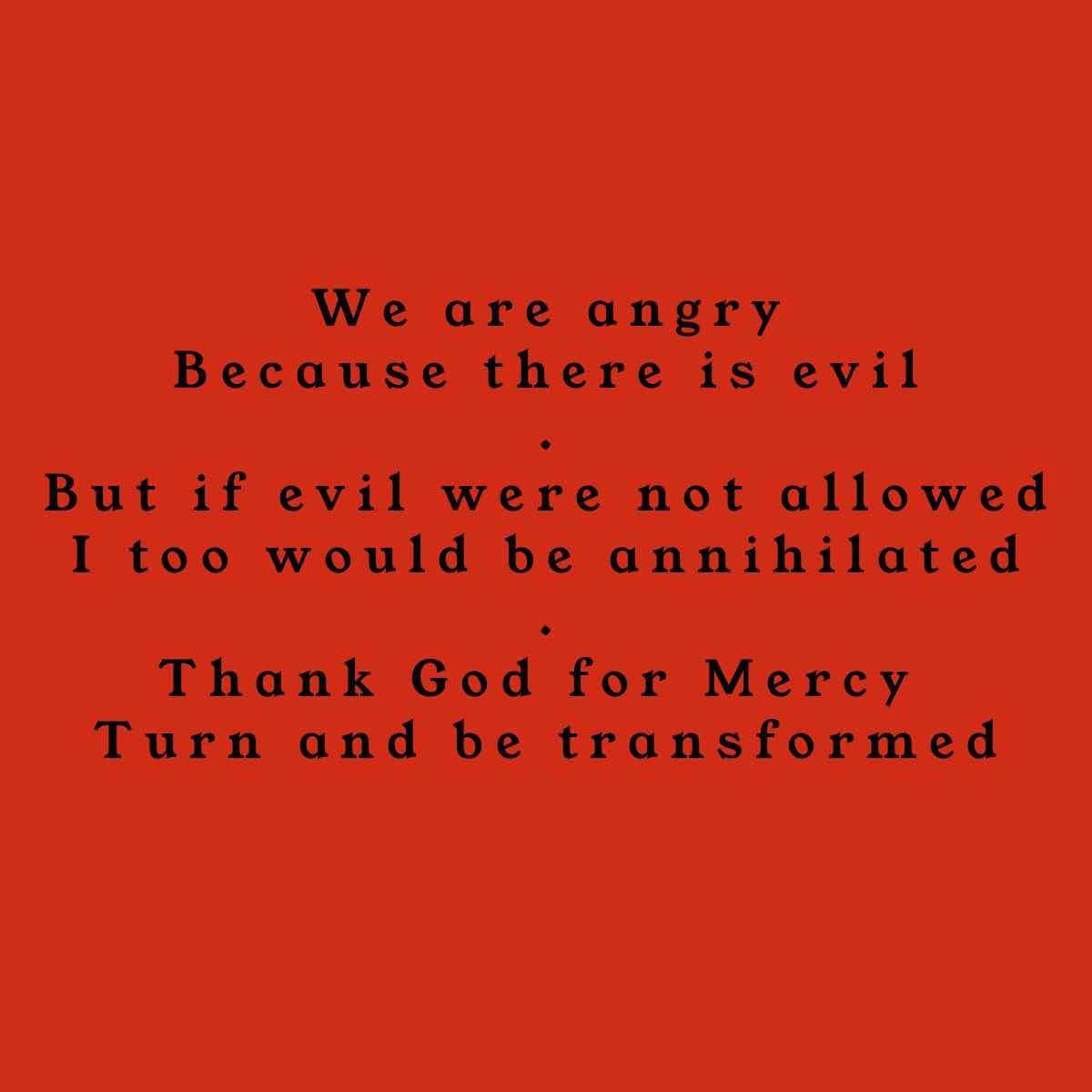
We are angry
Because there is evil
But if evil were not allowed
I too would be annihilated
Thank God for Mercy
Turn and be transformed
Stop Studying
PRACTICE!
FIGHT
your sin
at the Throne of Grace
I Peter 2
Put away malice, deceit, hypocrisy, envy, and slander
As exiles abstain from passions of the flesh, which wage war against my soul
Grow up into salvation
You have tasted that the Lord is good
come to him
the living stone
chosen and precious in the sight of God
I am a living stone being built into a spiritual house,
to be a holy priesthood,
to offer spiritual sacrifices,
acceptable to God through Jesus
Whoever believes in him
will not be put to shame
it is an honor to believe
I am a chosen race,
a royal priesthood,
a holy nation
a people of God‘s possession
I am to proclaimed the excellences of him
He who called me out of darkness
into his marvelous light.
I have now received mercy.
Live as free people
not to cover up evil,
but to live as a servant of God,
honor everyone
love the brotherhood
fear God
If you suffer for doing good and endure it,
this is a gracious thing in the sight of God
Christ suffered for you
you are to suffer for him
follow in his steps
Entrust yourself to the one who judges justly
I am to die to sin
and live to righteousness
Jesus was Rejected by men
For those who do not believe
Jesus is a stone of stumbling
and a rock of offense
They stumble and disobey
as they were destined to do
God, in His omniscience, has appointed the consequences of disobedience for those who reject His word. This does not imply that God causes unbelief, but rather that He has foreordained the outcome of rejecting Christ.
sin is punished by sin; for sin in God's awful judgment hardens the heart; the disobedient are in danger of eternal sin
~~~
Predestination, in its broadest sense, refers to God's eternal decree by which He has determined the fate of all rational beings, particularly concerning their supernatural end. This includes a twofold aspect: one aspect pertains to those who are predestined to eternal happiness in heaven, while the other relates to those who are not saved, often referred to as reprobation1. The Catholic Church emphasizes that predestination is primarily about God's initiative and grace, which precedes human action. It is not merely a passive foreknowledge but an active decree that involves God's will to save certain individuals.
grace responds to the deepest yearnings of human freedom and calls for cooperation
God's grace is necessary for salvation, individuals must freely cooperate with that grace
some individuals, through their own free will, may choose to reject God's grace, resulting in their eternal separation from Him
The concept of reprobation, which refers to the state of those who are not saved, is often a point of contention. The Catholic Church teaches that reprobation is not an arbitrary decision by God but is a consequence of human choices. Those who die in a state of sin or reject God's grace are said to be reprobated, which aligns with the scriptural references to judgment and the consequences of sin1. The Church maintains that God's justice and mercy are perfectly balanced; thus, while He desires all to be saved, He respects human freedom and the choices individuals make
This grace is not imposed but offered, allowing for genuine human freedom in accepting or rejecting it
This freedom is essential for authentic love and relationship with God. The Church teaches that if God were to override human freedom, it would undermine the very nature of love and moral responsibility4. Therefore, the lack of salvation for some individuals is not seen as a failure on God's part to grant grace, but rather as a result of their own choices in response to that grace.
God's plan for salvation is inclusive, and His grace is sufficient for all who seek it2. However, the reality of human sin and the consequences of free choices lead to the tragic situation where some may not attain salvation
the lack of salvation for some individuals is not attributed to God withholding grace but rather to the exercise of human free will in accepting or rejecting that grace.
The theological understanding of God's active decree regarding salvation, particularly in relation to predestination, is a complex and nuanced topic within Catholic theology. It encompasses the notions of divine foreknowledge, grace, and the interplay between God's will and human free will.
### Predestination Defined
Predestination, in its broadest sense, refers to God's eternal decree by which He has determined the fate of all rational beings, particularly concerning their supernatural end. This concept is rooted in the belief that God, in His omniscience, foresees all events and has a plan for each individual. Specifically, predestination is often divided into two categories: one that pertains to those chosen for eternal life (the elect) and another that relates to those who are not (often referred to as reprobation) [^1].
### The Nature of God's Decree
The decree of predestination is characterized by several key elements:
1. **Divine Foreknowledge**: God possesses infallible knowledge of all future events, including the choices that individuals will make. This foreknowledge does not negate human free will; rather, it encompasses it. God knows who will respond positively to His grace and who will not, and this knowledge is integral to His predestining action [^1].
2. **Immutable Will**: The decree of predestination is immutable, meaning that once God has chosen the elect, this decision cannot be altered. This is based on the belief that God's will is perfect and unchangeable, ensuring that those whom He has predestined will ultimately attain salvation [^1].
3. **Grace and Justification**: The process of predestination involves several stages, beginning with God's initial grace (vocation), followed by additional graces leading to justification, perseverance, and ultimately glorification. This underscores the belief that salvation is a gift from God, initiated by His grace, rather than a result of human merit [^1].
### Theological Perspectives
The theological discourse surrounding predestination has been significantly influenced by figures such as St. Augustine, who argued against the Pelagian view that human beings can achieve holiness through their own efforts alone. Augustine emphasized that God's grace is essential for salvation and that predestination is a manifestation of God's mercy and justice [^2][^3].
The Pelagians and Semi-Pelagians, in contrast, posited that God's predestination was based on His foreknowledge of human actions, suggesting that individuals could choose to be holy through their own free will. This view has been largely rejected in Catholic theology, which maintains that God's grace is the primary cause of salvation [^3].
### The Universal Salvific Will
While the concept of predestination implies that not all individuals are chosen for salvation, Catholic teaching also affirms the universal salvific will of God. This means that God desires all people to be saved and has provided the means for salvation through Jesus Christ. The Church teaches that God's grace is available to all, and individuals are called to respond to this grace [^4][^5].
Pope John Paul II emphasized that God's mercy and love extend to all humanity, and the Church's mission is to proclaim this message of salvation to every person [^7]. This perspective aligns with the understanding that while some may ultimately reject God's grace, the offer of salvation is universally extended.
### Conclusion
In summary, the theological understanding of God's active decree regarding salvation, particularly in relation to predestination, highlights the interplay between divine foreknowledge, grace, and human free will. While it acknowledges that some individuals are chosen for salvation, it also affirms God's universal desire for all to be saved. This duality reflects the richness of Catholic teaching on salvation, emphasizing both God's sovereignty and His profound love for humanity.
[^1] [Catholic Encyclopedia Predestination](https://www.magisterium.com/?page=documents&document=f2c979a8-871d-4f46-a059-320d3b837a76&ref=Predestination)
[^2] [On the Predestination of the Saints Book I, Introduction](https://www.magisterium.com/?page=documents&document=bc0f890d-1321-406d-b8f8-9c0f7e4d2383&ref=Book%20I,%20Introduction)
[^3] [On the Predestination of the Saints Book I, Chapter 38 [XIX.]— What is the View of the Pelagians, and What of the Semi-Pelagians, Concerning Predestination.](https://www.magisterium.com/?page=documents&document=bc0f890d-1321-406d-b8f8-9c0f7e4d2383&ref=Book%20I,%20Chapter%2038%20[XIX.]%E2%80%94%20What%20is%20the%20View%20of%20the%20Pelagians,%20and%20What%20of%20the%20Semi-Pelagians,%20Concerning%20Predestination.)
[^4] [Select Questions on the Theology of God the Redeemer IV.22](https://www.magisterium.com/?page=documents&document=772f08f1-765f-4eec-8b56-4e8c110aa348&ref=IV.22)
[^5] [Christianity and the World Religions 29](https://www.magisterium.com/?page=documents&document=ca528f3a-39e7-450e-971c-05ef95f7937b&ref=29)
[^6] [Redemptoris Missio 12](https://www.magisterium.com/?page=documents&document=4c57429b-d2a1-4a1c-8f32-82e24a4e69a2&ref=12)



No comments:
Post a Comment