
Textual Basis (Old Testament):
• NKJV: Based on the Masoretic Text (via Biblia Hebraica Stuttgartensia), just like the original KJV, with some comparisons to ancient versions (Septuagint, DSS, etc.).
• ESV: Also based on the Masoretic Text (BHS), but more willing to emend or adjust readings when the Hebrew is obscure or problematic, using the Septuagint, Dead Sea Scrolls, or other ancient sources.
Verdict: Both are rooted in the Masoretic Text, but NKJV sticks more strictly to it, while ESV allows more scholarly flexibility.
⸻
Translation Style:
• NKJV: Formal equivalence (word-for-word), preserves the rhythm and style of the original KJV with updated language.
• ESV: Also formal equivalence, but more modern and readable, aiming for both accuracy and literary quality.
Verdict: NKJV retains more of the KJV “feel”; ESV is more modern and streamlined.
⸻
Theological/Doctrinal Use:
• NKJV: Popular among more conservative, traditional, and KJV-loyal groups.
• ESV: Widely used in Reformed, evangelical, and academic settings.
⸻
Which is better for the Masoretic Text?
• If you want a translation that adheres very closely to the Masoretic Text, especially in tradition and style, go with the NKJV.
• If you’re okay with occasional use of other ancient sources to clarify or improve translation and want a cleaner modern style, the ESV might be the better fit.
Jews traditionally use the Masoretic Text (MT) as the authoritative manuscript of the Old Testament, or Tanakh in Hebrew. The Masoretic Text is a carefully preserved version of the Hebrew Scriptures, compiled and standardized by Jewish scholars known as the Masoretes between the 7th and 10th centuries CE.
Some key points:
• It’s written in Biblical Hebrew, with a few portions in Biblical Aramaic.
• The Masoretes added vowel points and cantillation marks to help with pronunciation and chanting since the original Hebrew was consonantal.
• The Aleppo Codex and the Leningrad Codex are among the most important and complete surviving manuscripts of the Masoretic Text.
This version is the basis for most modern Jewish Bibles and also heavily influenced many Christian Old Testament translations.
Many Christian Bibles—especially Protestant ones—use the Masoretic Text (MT) as the primary source for the Old Testament, just like Jewish tradition does. Here’s a breakdown:
Christian Bibles that primarily use the Masoretic Text:
• King James Version (KJV)
• New International Version (NIV)
• English Standard Version (ESV)
• New American Standard Bible (NASB)
• Christian Standard Bible (CSB)
These translations are mostly based on the Masoretic Text, particularly the Leningrad Codex, often supplemented with comparisons to other sources like the Septuagint (Greek translation) or the Dead Sea Scrolls when the Hebrew is unclear or disputed.
Exceptions or differences:
• Catholic and Eastern Orthodox Bibles include the Deuterocanonical books (aka the “Apocrypha”) and sometimes rely more heavily on the Septuagint (LXX) for the Old Testament, especially in the Orthodox tradition.
• Example: The Douay-Rheims Bible and the Septuagint-based Orthodox Study Bible lean more on the LXX than the MT.
So in short: most Protestant Bibles use the same Hebrew manuscript tradition (Masoretic Text) as Judaism for the Old Testament.
Yes, the New King James Version (NKJV) primarily uses the Masoretic Text for the Old Testament.
Specifically:
• The NKJV Old Testament is based on the Biblia Hebraica Stuttgartensia (BHS), which is a critical edition of the Masoretic Text, primarily following the Leningrad Codex (the oldest complete MT manuscript).
• The NKJV translators did consult other sources—like the Septuagint (LXX), Dead Sea Scrolls, Samaritan Pentateuch, and Targums—but only as comparative tools or to clarify difficult passages, not as the main source.
So yes, the NKJV maintains the Masoretic Text as its foundation for the Old Testament, just like the original KJV and many other Protestant translations.
Jesus' statement that "salvation is from the Jews" (John 4:22) highlights the historical context of salvation history. God chose the Jewish people to be the recipients of his initial revelation and covenants 1 2. From this lineage came Jesus Christ, the Messiah and Savior of the world 3.
The Old Testament in Catholic Tradition
The Catholic Church views the Old Testament as an indispensable part of Sacred Scripture 4 5. The books of the Old Testament are divinely inspired and retain permanent value because the Old Covenant has never been revoked 4 5. These scriptures bear witness to God's saving love and prepare for the coming of Christ 5.
Unity of the Old and New Testaments
The Old Testament prepares for the New Testament, and the New Testament fulfills the Old 2 6 7. Both Testaments shed light on each other and are considered the true Word of God 2 6 7. The Old Testament reveals the knowledge of God and humanity, displaying God's justice and mercy 3. It contains sublime teachings, wisdom, and prayers, with the mystery of salvation present in a hidden way 3 8.
The Church's Use of the Old Testament
The Church has always preserved the Old Testament, regarding it as a heritage 2. Discarding the Old Testament would render the New Testament incomprehensible 9. The Old Testament reveals God's gradual and patient teaching, leading humanity toward union with God 9.
Therefore, while salvation comes through Jesus Christ, who is of Jewish descent, the Old Testament (which is the Jewish Bible) is integral to understanding God's plan of salvation 3 2. The Catholic Church reveres and utilizes the Old Testament as a vital part of its scriptures, interpreting it in light of the New Testament and the teachings of Christ 3 8.
The New King James Version (NKJV) and the English Standard Version (ESV) are both popular Bible translations, but there are differences in wording, phrasing, and sometimes in the inclusion or exclusion of certain verses or phrases. The NKJV is a more traditional translation based on the Textus Receptus and the Majority Text, while the ESV is a more modern translation based on the critical text (which relies on older manuscripts like the Alexandrian texts).
Yes, there are some differences in verse inclusion between the New King James Version (NKJV) and the English Standard Version (ESV)—mainly due to how each translation handles textual variants in ancient manuscripts.
Background:
• The NKJV is based on the Textus Receptus (the same Greek text behind the original King James Version), with comparisons to newer manuscript evidence.
• The ESV is based on more modern critical texts like the Nestle-Aland and UBS, which rely heavily on earlier manuscripts.
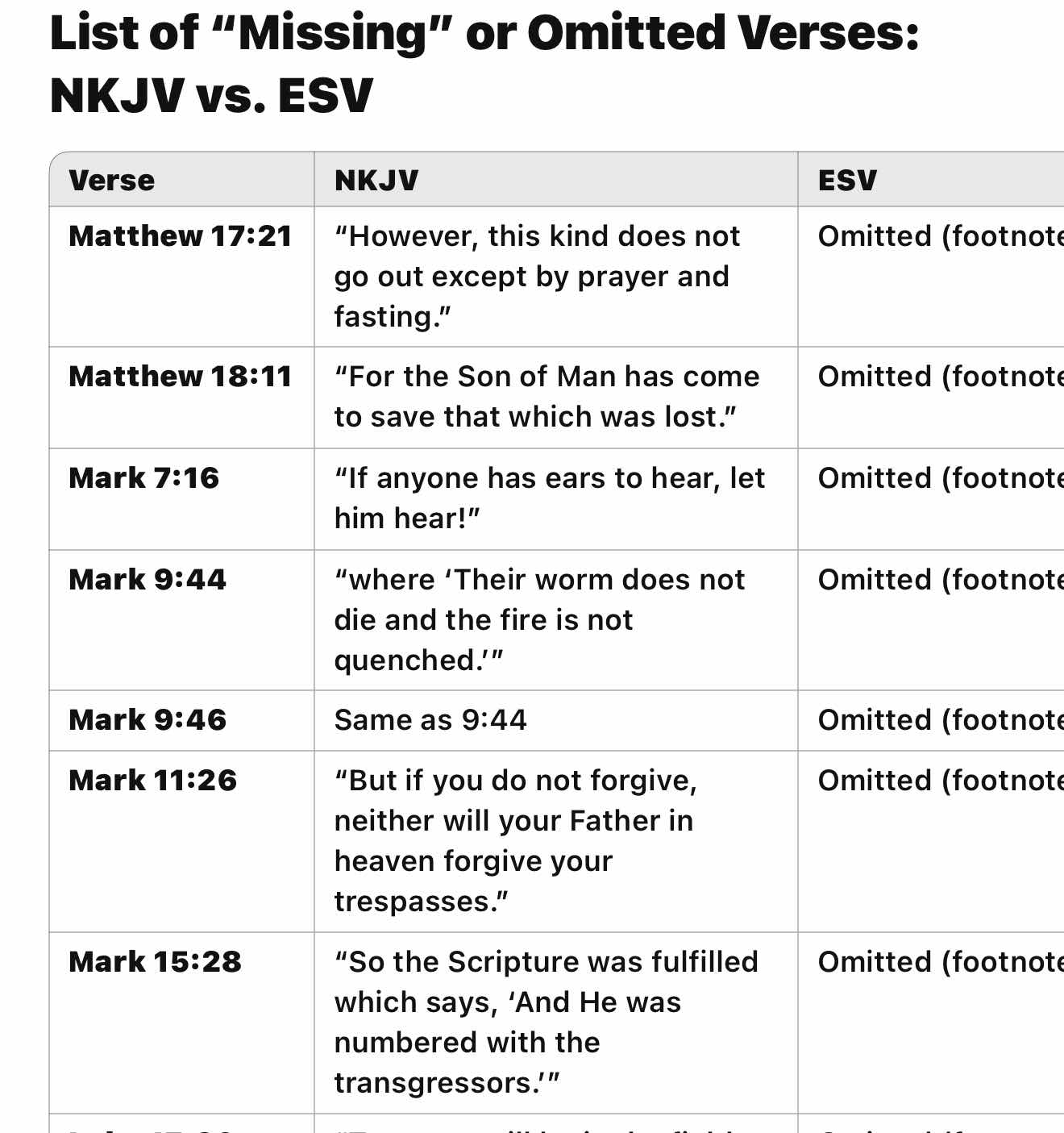
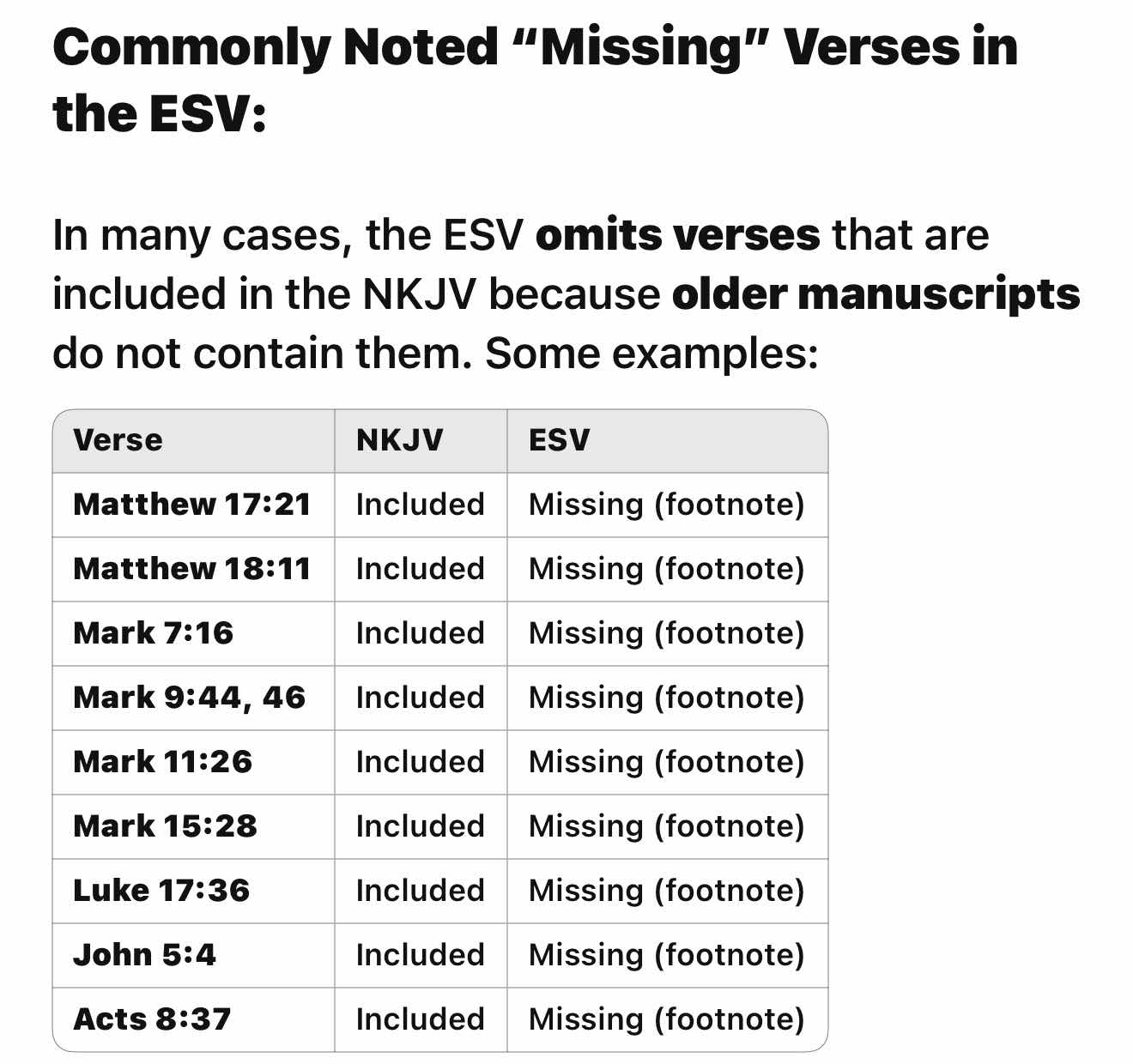
While both versions include most of the same verses, there are a few instances where verses or portions of verses in the NKJV are omitted or bracketed in the ESV due to differences in manuscript evidence. Some of these include:
Examples of verses/phrases found in NKJV but not in ESV:
1. Matthew 17:21 (NKJV: “However, this kind does not go out except by prayer and fasting.”)
• The ESV omits this verse, as it is not found in some of the earliest manuscripts.
2. Matthew 18:11 (NKJV: “For the Son of Man has come to save that which was lost.”)
• The ESV omits this verse as it is absent from early Greek manuscripts.
3. Mark 7:16 (NKJV: “If anyone has ears to hear, let him hear.”)
• The ESV omits this verse.
4. Mark 9:44 and Mark 9:46 (NKJV: “Where ‘Their worm does not die and the fire is not quenched.’”)
• Both of these verses are omitted in the ESV.
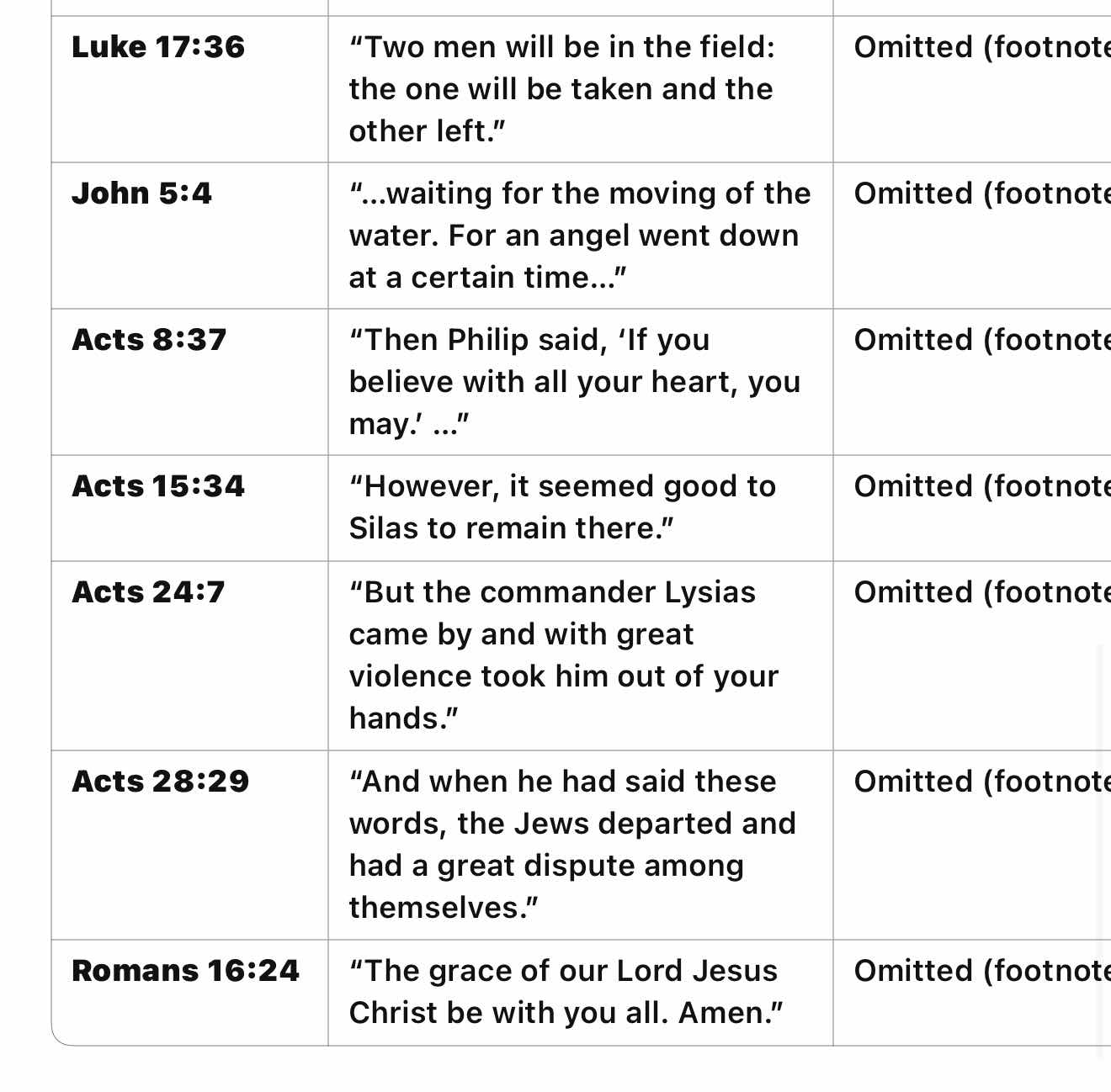
5. Luke 17:36 (NKJV: “Two men will be in the field: the one will be taken and the other left.”)
• The ESV omits this verse.
6. John 5:4 (NKJV: “For an angel went down at a certain time into the pool and stirred up the water; then whoever stepped in first, after the stirring of the water, was made well of whatever disease he had.”)
• This portion is omitted or placed in brackets in the ESV, reflecting its absence in some early manuscripts.
7. Acts 8:37 (NKJV: “Then Philip said, ‘If you believe with all your heart, you may.’ And he answered and said, ‘I believe that Jesus Christ is the Son of God.’”)
• The ESV omits this verse.
8. Romans 16:24 (NKJV: “The grace of our Lord Jesus Christ be with you all. Amen.”)
• This verse is omitted in the ESV.
9. 1 John 5:7-8 (The Comma Johanneum)
• The NKJV includes the famous Trinitarian formula (“For there are three that bear witness in heaven: the Father, the Word, and the Holy Spirit; and these three are one.”) while the ESV omits this part because it does not appear in early Greek manuscripts.
Summary:
The NKJV contains some verses and phrases that are omitted or placed in brackets in the ESV, largely due to differences in the manuscript traditions on which each translation is based. The ESV tends to rely more on earlier and more reliable manuscripts, and some verses were likely added later in the history of the text, which is why they appear in the NKJV but not in the ESV.
While the ESV (English Standard Version) and NKJV (New King James Version) are based on different sets of Greek and Hebrew manuscripts, they both contain the same core biblical content. However, in terms of verse inclusion, the differences generally arise from the fact that the ESV sometimes omits verses or phrases based on its reliance on older, more critically regarded manuscript traditions, particularly the Alexandrian text family.
To clarify: there are no verses in the ESV that are not in the NKJV. However, there are verses in the NKJV that are sometimes omitted or marked with a note in the ESV because they are not found in the earliest manuscripts or are considered to be later additions (such as in the case of the Comma Johanneum or other disputed passages). So, in a sense, the NKJV includes some verses that the ESV does not, but not the other way around.
Key Differences:
The main differences between the two translations generally involve omissions or changes in specific wording, rather than any verses being entirely exclusive to the ESV.
For example:
1. Matthew 17:21 (NKJV) is omitted in the ESV.
2. Matthew 18:11 (NKJV) is omitted in the ESV.
These are verses that are found in the NKJV but are either omitted or bracketed in the ESV due to their absence in the earliest manuscripts.
Conclusion:
The ESV does not contain any verses that are specifically excluded from the NKJV. The NKJV, on the other hand, may include some verses that are absent in the ESV due to different manuscript traditions. However, both translations share the vast majority of the same text, with the ESV being more cautious about including verses not supported by the earliest and most reliable manuscript evidence.
Great question — and the short answer is: No, the NKJV does not omit any verses that are included in the ESV.
Why?
The NKJV was intentionally translated to preserve the traditional verse set found in the KJV, which includes all the verses from the Textus Receptus (a later manuscript tradition). That means the NKJV actually contains more verses than the ESV, not fewer.
On the other hand:
The ESV uses a critical text (based on older manuscripts), which omits or footnotes verses that are considered likely later additions. So:
• All verses in the ESV are also in the NKJV (though sometimes worded slightly differently).
• There are no known verses that are in the ESV and missing from the NKJV.
If you’re using the NKJV and comparing it with the ESV, you’ll sometimes see the ESV skip a verse number — and that’s your clue that it’s omitted or footnoted due to manuscript reasons.
Would you be interested in a side-by-side verse comparison of a specific passage to see how this plays out?

No comments:
Post a Comment